Last updated 8.7.2026
As soon as you step off the plane, you might be wondering whether you’ve landed on Mars. Vast black lava fields and a volcanic landscape full of craters will stay in your memory for a long time. Thanks to the visionary César Manrique, the island has preserved its face and character. What to see in Lanzarote? We’ve put together 20 of the most beautiful places in Lanzarote that are absolutely worth visiting.
Why You Can Travel to Lanzarote Any Time of the Year
Lanzarote is part of the Canary Islands. The weather is pleasant all year round: even in winter you can expect temperatures around 20 °C, while in summer it rarely goes above 30 °C. You’ll warm up in winter and won’t get roasted in summer, so it’s an ideal destination for travelling throughout the year. And because volcanoes are love – there are more than 300 of them here, plus huge lava fields. That’s why I personally wanted to go here at least.
How to Get to Lanzarote and How to Get Around
You’ll fly to Lanzarote via Arrecife Airport (ACE). Direct flights from Prague are operated by SmartWings; you can often get here cheaper from Vienna. The flight takes about 5 hours. If you want to explore the island properly, rent a car – it’s still Spain and public transport isn’t 100%. Roads are quite decent, nothing complicated, and driving is easy. Buses connect the main towns and resorts, but you often can’t reach nature reserves with them.
TIP: What to pack for your holiday? We’ve prepared the best holiday packing list, wherever you’re going.

Lanzarote Accommodation – Where Is the Best Place to Stay?
We travelled all over Lanzarote, so we moved around a lot – and thanks to that we have plenty of tips for places we liked. Want to stay in just one area? If you’re looking for busy nightlife and long beaches, head to Puerto del Carmen. If you want family-friendly calm and modern resorts, Playa Blanca is ideal. If you prefer luxury resorts and windsurfing, go for Costa Teguise. And if you want a quieter spot close to the airport, choose Playa Honda.
- Playa Blanca: Hotel The Mirador Papagayo – a beautiful hotel with amazing views.
- Los Charcones: Bungalows Playa Limones – simple bungalows close to Los Charcones.
- Charco de los Clicos (El Golfo): Casa El Morro – rustic accommodation in a traditional style.
- La Geria: La Casona de Yaiza – romantic accommodation surrounded by vineyards.

20 Places to See in Lanzarote
What to see in Lanzarote? We’ve selected 20 of the most beautiful places in Lanzarote that are absolutely worth visiting. We loved Caldera Blanca the most, Timanfaya National Park, the La Corona volcano, and the Playa de Papagayo beach. And of course the incredible views from all kinds of viewpoints and the lava fields. Basically, it’s beautiful as a whole – because I genuinely feel like I’m on Mars here.
The Capital of Lanzarote: Arrecife
The capital of Lanzarote might feel a bit chaotic, but it hides more than it seems at first glance. In the center lies the Charco de San Ginés lagoon, and the historic core is protected by the small fortress Castillo de San Gabriel, which you reach via a stone bridge over the sea. We really liked the small city beach in the center, where we would come to take a nap, do yoga, or swim.
Most people will end up in Arrecife because all roads and bus lines lead here. From the airport you’ll be here by car in ten minutes, or by bus no. 22.
ACCOMMODATION TIP: If you plan to stay a few days in the capital, we recommend Hostal San Ginés, which is practically on the beach.
Timanfaya National Park – The Fire Mountains
Timanfaya National Park is the place almost every traveller will visit. It feels like a gateway to the center of the Earth. Black lava plains, orange cones, and red volcanic slopes make you feel like you’ve landed on another planet. Covering more than 50 km², the park was formed after a series of eruptions in the 18th century that lasted six years.
Practical Information & Entrance
Access is only possible with a guide and by bus along the circular route Montañas del Fuego, where you’ll also see geothermal demonstrations: water poured into a hole turns into a geyser within seconds. A unique highlight is the El Diablo restaurant, where meat is grilled directly over volcanic heat. You can reach the park via the LZ-67 road between Yaiza and Tinajo.

TIP: Timanfaya National Park in Lanzarote – How to get here and what not to miss?
Where to Stay Near Timanfaya National Park
Obviously you can’t stay inside the park, but there are three nice places nearby. We spent a few weeks in Lanzarote and travelled all over it, so we moved around a lot.
- Yaiza: Yaiza is very close. You can stay in the cozy Casa de Hilario, just minutes from the park, or choose the better Hotelito La Era B&B in Mancha Blanca.
- Puerto del Carmen: In Puerto del Carmen, you’ll appreciate the reasonably priced Hotel Lanzarote Village, or treat yourself to the legendary Lani’s Suites de Luxe right by the ocean.
TIP: We recommend booking an organized trip via GetYourGuide, where you know exactly what you’re buying, how it works, and you don’t have to worry about anything. These trips are especially useful if you don’t have your own car.

Caldera Blanca – The Largest Crater in Lanzarote
Lanzarote – what to see and what else not to miss? One of the places we remember most fondly is the island’s largest crater: Caldera Blanca. In the middle of a lava field north of Timanfaya, the monumental cone of Caldera Blanca rises, more than one kilometer wide. The hike to the top takes about two hours, but the views are worth it – you can see the entire sea of lava all the way to the ocean.
The starting point is near the village of Mancha Blanca, where you can park easily. Bring plenty of water because there’s no shade. We combined this hike with a visit to Timanfaya National Park.
Playa de Famara – A Surfer’s Paradise
On the northwest coast lies Playa de Famara, a huge sandy beach backed by the monumental cliffs of Risco de Famara. The water is cooler and the wind is stronger – ideal for surfers and kitesurfers. At low tide, the sand shines like a mirror, and combined with an orange sunset it becomes one of the most photogenic places on the island.
You can get to Famara from Teguise via the LZ-402; you can park right by the beach. Even if you’re not planning to surf, sit on the sand and watch the ocean constantly change – this place has a special calm energy.
TIP: Fuerteventura review: Tips, experiences, and what you should know before you go

Caldera Trasera
If you’re near Famara beach and want to do a shorter walk through volcanic scenery, head to the top of Caldera Trasera. Leave your car in the village of Soo and continue on foot. It’s hard to get lost. Walk towards Pico Prieto and you’ll be at the top in no time.

Mirador del Río
Almost 500 meters above sea level, on the edge of the Risco de Famara cliff, stands César Manrique’s architectural masterpiece – Mirador del Río. From the outside it looks inconspicuous, but inside you’ll find a space that seems to grow out of the rock. Huge windows frame views of La Graciosa island, the Atlantic Ocean, and nearby islets. The best time to visit is in the morning, when the light brings out the contrast between turquoise water and red lava. You can reach the viewpoint via the LZ-202 road from Haría. And on a clear day, you can even see the mountains of Fuerteventura from here.
Playa del Papagayo – The Most Beautiful Beach on the Island
At the very south of Lanzarote, in the Los Ajaches nature reserve, lies the golden beach Playa del Papagayo. The water here is incredibly clear, calm, and warm – ideal for swimming and snorkeling. If you’re staying in the Playa Blanca area, it’s about a 15-minute drive.
From the parking lot, it’s about a five-minute walk. On site there’s only a small bar with an ocean view – no hotels, no music, just silence and a turquoise lagoon. Locals say Papagayo is “the closest to the Caribbean you can get without a passport.”
ACCOMMODATION TIP: The south of Lanzarote is a bit more expensive, but you can stay, for example, in an adults-only hotel or at the charming and beautiful Grupotel Flamingo Beach.
Charco de los Clicos & the Village of El Golfo – Lanzarote’s Green Eye
Do you know the iconic green lake in Lanzarote? In a small bay west of El Golfo lies Charco de los Clicos, a lagoon with bright green water. The color comes from microscopic algae living in saltwater separated from the ocean by a thin strip of sand. Above the lagoon rise red and black volcanic layers, which is why this place has become a phenomenon and an icon of the island.
You walk to the lagoon from the parking lot; the best view is from the viewpoint above. You can also walk down to the beach and even go for a swim.

Jameos del Agua – Art Inside a Cave
Just a few kilometers from Cueva de los Verdes lies another lava tunnel, transformed by César Manrique into a unique work of art – Jameos del Agua. Inside the underground complex you’ll find a natural pool with endemic tiny white crabs found nowhere else in the world. Next to the pool is an amphitheater that hosts concerts, and an outdoor swimming pool surrounded by palm trees – the whole place feels like an oasis of calm and beauty.
Plan this visit together with Cueva de los Verdes, as they are close to each other and often offer discounted combined tickets.
TIP: Fuerteventura: What to see + 30 most beautiful places
Los Hervideros Rock Formations
On the west coast between El Golfo and Salinas de Janubio you’ll find the very unusual Los Hervideros rock formations. Lava once flowed into the sea here; the ocean cooled it and created a network of caves and openings that powerful Atlantic waves crash into today. Water smashes against the walls, roars, and sprays high above the cliffs – it’s the most impressive at high tide. A short road leads here from Playa Blanca, and the parking lot is free. Nearby you’ll also find the traditional salt flats Salinas de Janubio, where seawater evaporates.
Fun fact: Many buildings have only two or three floors thanks to strict rules set by architect César Manrique, who banned high-rise hotel construction in Lanzarote so the island wouldn’t lose its character.
Cueva de los Verdes – The Secret of the Underground World
In the north of the island, beneath the La Corona volcano, lies a 6 km-long underground lava tunnel – Cueva de los Verdes. The cave formed more than 4,000 years ago and once served locals as a hideout from pirates. Today it’s open to the public, and visitors walk through color-lit domes and corridors that create a magical atmosphere. At the end of the tour, a surprise awaits – guides won’t reveal it, you have to experience it for yourself.
The entrance is from the main road between Órzola and Haría; you can leave your car in the parking lot by the entrance. And a little extra? Concerts are held in the cave because it has unique acoustics unlike anywhere else in the Canary Islands.
TIP: 23 great places to go to the sea in Europe in April
Jardín de Cactus – César Manrique’s Cactus Paradise
On the edge of the village of Guatiza, on the site of a former quarry, stands the Cactus Garden, one of César Manrique’s most iconic works. In an amphitheater-like hollow you’ll find more than 10,000 species of cacti from all over the world – from huge columnar varieties from Mexico to tiny spheres from Africa. Above the garden rises a white windmill, and a small café serves drinks made from cactus fruit.
You can reach Guatiza via the LZ-1 road from Arrecife or Teguise. Notice how Manrique blended modern design with nature – every curve here follows the shapes of the surrounding lava slopes.
La Geria – Vineyards on a Lunar Landscape
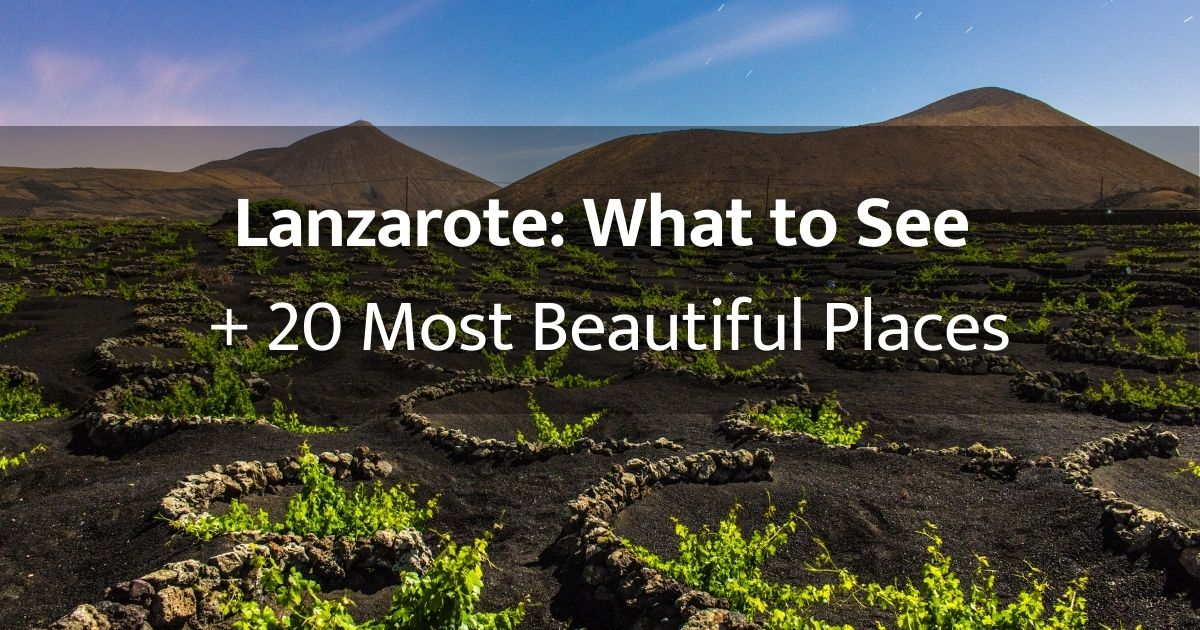
The first time you see La Geria, you might feel like someone planted vines on the Moon. Each vine grows in a small pit dug into black volcanic soil and is protected from the wind by a semicircular stone wall. This unique cultivation method means the vines draw moisture from night-time dew. The typical Malvasía wine has sweet, fruity notes and has won many awards.
You can reach the area via the LZ-30 road between Uga and San Bartolomé. Stop at one of the bodegas – for example El Grifo, the oldest winery in the Canary Islands (founded in 1775), where you can do a tasting and visit a small museum.
TIP: What to see in Cyprus? 39 most beautiful places to visit

The Town of Teguise
In the middle of the island, in the heart of Lanzarote, lies Teguise – the former capital. White houses with wooden balconies, narrow streets, and a square with the church of Nuestra Señora de Guadalupe create an old-time atmosphere. Teguise is at its liveliest on Sundays, when a big market takes place with local products, handmade jewelry, wine, and cheeses. You can reach the town via the LZ-10 from Arrecife; parking is available at the entrance to the historic center. A nice bonus is the Timple Museum, dedicated to the traditional Canary instrument – worth a short stop.
Punta Mujeres – The Village of Ocean Pools
On the northeast coast lies the quiet fishing village of Punta Mujeres, stretching along a lava shoreline. The ocean has formed natural pools here where you can swim safely, even when the sea outside is rough. Locals come here for an evening dip or tapas in small family-run bars. The village is just a few minutes’ drive from Jameos del Agua – perfect for a stop on the way.
Tip: bring snorkeling goggles – the water in the pools is unbelievably clear.
La Graciosa – The Island of Calm and Sand
Did you know there are officially 8 Canary Islands? In 2018, La Graciosa was officially recognized as the eighth inhabited island of the archipelago. If you’re staying in Lanzarote longer, we recommend taking a day trip to La Graciosa, just a 25-minute ferry ride from the port of Órzola. No paved roads, no big hotels – just sand, turquoise sea, and a handful of white houses. You can cycle around the island or rent a jeep and visit beaches like Playa de las Conchas or Playa Francesa, among the most beautiful in the entire archipelago.
ACCOMMODATION TIP: On La Graciosa you can stay at Apartamentos Graciosamar, just a short walk from the beach.

Monte Corona Volcano – The Birth of the Cave World
We were almost alone here. Monte Corona is a quiet yet majestic symbol of northern Lanzarote. It went extinct more than four thousand years ago, but its eruption created the cave system that includes Cueva de los Verdes and Jameos del Agua. From the village of Yé, a marked trail leads to the rim of the crater, with beautiful views over the sea and La Graciosa. The hike takes about an hour and is manageable for anyone with average fitness. Lanzarote – what to see and what else not to miss?
Lanzarote – What to See: Puerto del Carmen
Looking for a bit of life in Lanzarote? Yes, this island is very quiet and calm, and you’ll probably find plenty of retirees here too. Luckily, the island’s largest resort, Puerto del Carmen, offers long sandy beaches, a lively promenade, and plenty of bars and restaurants. Still, it has kept some of its original charm – the old fishing harbor El Varadero is full of small boats and tapas bars.
Nearby you’ll find Playa Grande, popular with families, while the smaller Playa Chica is a diver’s paradise. The resort is just 10 minutes from the airport and has excellent connections by bus and taxi.
TIP: Sri Lanka travelogue: How much a month in Sri Lanka cost us and what we experienced
Costa Teguise Resort
Looking for a place to surf or try windsurfing? On the east coast, a few kilometers from Arrecife, lies Costa Teguise – a modern but friendly resort that is a windsurfing hub, especially at Las Cucharas beach, where the wind is ideal almost all year round. There are cycling paths, a golf course, and a water park nearby. Thanks to the wind, it feels pleasant even in summer when other places are scorching hot. And from here it’s also close to Manrique’s attractions in the north of the island.
Yaiza – The Village That Survived the Volcanoes
The white town of Yaiza lies on the edge of the volcanic area and is often considered the most picturesque village on the island. Narrow streets, the Nuestra Señora de los Remedios church, and traditional houses with blue doors create a beautiful contrast with black lava in the background. From Yaiza it’s only a few minutes to Timanfaya, La Geria, or Los Hervideros. In the center you’ll find great restaurants serving traditional cuisine – La Bodega de Santiago is a top pick, with a gorgeous terrace.
Flights to Lanzarote – When Is the Best Time to Buy Them?
From Prague or Vienna you can reach Lanzarote on a direct flight or with a stopover. The flight takes roughly 5 hours. About 3 years ago we managed to get return tickets from Vienna for 1,000 CZK, so try to watch for deals. Prices have gone up a bit now, and in promotions you’ll usually see them around 2,000–5,000 CZK.
What the Weather in Lanzarote Is Like Throughout the Year
Below is an overview of average daily air temperatures for each month of the year. You’ll notice there isn’t such a big difference, so we recommend travelling outside peak season as part of slow travel – you’ll have it calmer.
| Month | Average daytime temperature* |
| January | ~ 20 °C |
| February | ~ 20 °C |
| March | ~ 21 °C |
| April | ~ 22 °C |
| May | ~ 23 °C |
| June | ~ 25 °C |
| July | ~ 27 °C |
| August | ~ 28 °C |
| September | ~ 28 °C |
| October | ~ 25 °C |
| November | ~ 23 °C |
| December | ~ 22 °C |
FAQ – Most Common Questions
What to see in Lanzarote?
2. Timanfaya National Park. Volcanic landscape, geothermal demonstrations, and El Diablo restaurant where food is grilled over volcanic heat.
3. Caldera Blanca. The largest crater in Lanzarote; a two-hour hike and views over lava fields and the ocean.
4. Playa de Famara. Sandy beach beneath the Risco de Famara cliffs; a surfer’s paradise and photogenic sunsets.
5. Risco de Famara. Cliffs and viewpoints over the north coast with panoramic ocean views.
6. Mirador del Río. A César Manrique viewpoint 500 m above sea level with views of La Graciosa.
7. Playa del Papagayo. Golden beach in the Los Ajaches reserve, crystal-clear water and a calm lagoon.
8. Charco de los Clicos & El Golfo. Green lagoon in a volcanic bay and a fishing village with great restaurants.
9. Jameos del Agua. César Manrique’s underground complex with a pool of white crabs and a concert hall.
10. Los Hervideros. Dramatic coast where Atlantic waves crash into lava and spray high into the air.
11. Cueva de los Verdes. Lava tunnel formed by the La Corona eruption, illuminated domes, and acoustic concerts.
12. Jardín de Cactus. Cactus garden with over 10,000 cactus species in Guatiza, created by César Manrique.
13. La Geria. Wine region on volcanic soil, traditional vine cultivation and Malvasía tastings.
14. Teguise. Former capital with white architecture, narrow streets, and Sunday markets.
15. Punta Mujeres. Fishing village in the northeast with natural ocean pools for swimming.
16. La Graciosa. Island without paved roads, sandy beaches, and the most peaceful vibe in the Canaries.
17. Puerto del Carmen. Largest resort on the island with long beaches, promenade, and nightlife.
18. Costa Teguise. Modern resort with Las Cucharas beach, perfect for windsurfing and families.
Where can you find white sand in the Canary Islands?
When is the best time to visit Lanzarote?
The most tourists come in summer (July–August) and winter (December–February), when the rest of Europe is freezing. If you want more peace and quiet, the best times are April–June or September–November – warm weather, fewer people, and still ideal conditions for swimming.
Where is it least windy in Lanzarote?
How do you communicate in the Canary Islands?
Potřebujete pomoct s cestováním?
-
Ubytování 🏨
Vyberte si to nejlepší ubytování, ať už jste kdekoliv, přes Booking.com. -
Půjčení auta 🚗
Auto si snadno najdete přes Booking.com, kde máte často slevu díky ubytování, nebo Rentalcars.com, kde porovnáte nabídky většiny půjčoven. -
Zážitky 🎟️
Přes GetYourGuide.com si vyberete z nejrůznějších výletů i zážitků po celém světě, navíc se zrušením zdarma do 24 h předem.