Langkawi Sky Bridge: The highest point in the jungle of Langkawi Island

Langkawi Sky Bridge: The highest point in the jungle of Langkawi Island

Langkawi Sky Bridge is one of the island’s greatest icons and a place you’ll remember long after returning home. It’s not just about the views, but about a unique combination of nature, architecture, and engineering courage that you won’t easily find elsewhere. The bridge arches high above the jungle of the Machinchang mountain range, giving you the feeling of walking somewhere between the sky and the earth. What should you know if you’re planning to visit?

Langkawi Sky Bridge – what it actually is

The bridge itself is 125 meters long, has an elegant curved shape, and is suspended from a single massive pylon, making it one of the longest curved suspension bridges in the world. The curve is no coincidence – as you walk, the perspective constantly changes and the views gradually open in every direction. At one moment you’re looking deep down into the green jungle, the next at limestone cliffs and mountain ridges, and on clear days even at the Andaman Sea and surrounding islands, sometimes all the way to Thailand’s Tarutao.

TIP: Skip the lines and buy your Sky Bridge tickets online in advance via GetYourGuide and avoid the hassle.

Langkawi Sky Bridge: The highest point far and wide in the jungle of Langkawi Island

How to get to Langkawi Sky Bridge

Visiting the Sky Bridge starts in Oriental Village, a small tourist village at the foot of the mountains, where you can park and board the Langkawi SkyCab cable car. The cable car ride itself is one of the steepest in the world and an attraction on its own. It takes you to the first viewing peak of Mount Mat Cincang, where you can walk around and enjoy the scenery. Then you continue to the second peak, from where you reach the bridge entrance.

From the upper station, you have two options: either take the SkyGlide inclined elevator, which comfortably takes you down to the bridge in just a few minutes, or walk down a steep mountain trail, which takes about 10–20 minutes. The walking option is cheaper but slippery and physically more demanding, especially after rain. But as they say, the harder the journey, the greater the experience.

Why everyone goes to Langkawi Sky Bridge

Langkawi Sky Bridge is not just a tourist attraction, but a true engineering marvel. The bridge was built from individual segments that were transported to the mountain peak by helicopter and assembled on site. The entire structure hangs from a single pylon over 80 meters tall, anchored deep into the rock. The bridge is designed to support up to 250 people at once, yet it still feels light and airy.

As you walk, you’ll notice steel railings and safety nets that don’t obstruct the views. At both ends of the bridge, there are triangular viewing platforms where you can rest, take photos, or simply stand and gaze into the valley below. One section even features a transparent floor panel, adding an extra dose of adrenaline to the experience.

TIP: Langkawi Island is a tropical paradise with waterfalls and mountains. Where should you go? We know the 20 most beautiful places on the island.

Langkawi Sky Bridge: The highest point far and wide in the jungle of Langkawi Island

Langkawi Sky Bridge – practical visitor information

Access to the Sky Bridge is only possible via the SkyCab cable car, and the bridge ticket is purchased separately. The base price of the cable car is 55 Malaysian ringgit, which usually includes a short SkyDome projection. Other attractions in the area are paid separately. Prices may change from year to year.

The bridge has been closed several times in the past for maintenance and reinforcement, but today it is fully open and safe. It’s best to visit early in the morning or later in the afternoon, when there are fewer people and better light for photos (let’s be honest – you’ll want proof you were really here). In strong winds or poor visibility, cable car and bridge operations may be temporarily suspended.

TIP: Nusa Penida Island – Indonesia: 23 places to go for adventure

It’s not for everyone – if you’re afraid of heights

To be fair, the Sky Bridge is not ideal for those with a serious fear of heights. The bridge sways slightly, is relatively narrow, and the drop beneath you is very real. But that’s exactly why most people come here – the feeling of standing hundreds of meters above the jungle is hard to put into words. Those who overcome their fear rarely regret it, and the Sky Bridge often becomes one of the strongest experiences of the entire Langkawi trip.

TIP: Fuerteventura: What to See + 30 Most Beautiful Places

15 tips for the best Polish campsites by the sea

15 tipů na nejlepší polské kempy u moře

Poland is becoming an increasingly popular destination for summer vacations. And it’s no surprise: wide sandy beaches, clear seas, beautiful nature, and affordable prices attract tourists from all over Europe (especially from the Czech Republic). If you’re looking for freedom and beautiful scenery, want to travel on a budget, or simply don’t have time for a long trip, head to the Polish seaside. We regularly go camping on the Polish coast and have absolutely fallen in love with it. So, what are the best campsites along Poland’s Baltic coast?

How are the highways in Poland

Traveling by car in Poland is much more pleasant these days, and most highways are toll-free. For example, the entire A1 highway from the south of the country to Gdańsk is currently free. So, when we left Ostrava, our navigation told us to continue straight for 600 km after just two turns, and we were there. However, some sections, especially those that are privately operated, are still an exception and require you to pay tolls.

Wildcast camping in Poland

If you’re drawn to the freedom of wild camping by the Baltic Sea, it’s important to know the rules. In general, you can legally spend the night anywhere it is not expressly forbidden. Be sure to avoid private land without the owner’s permission, forests outside of designated areas, national parks, and nature reserves. Above all, forget about camping on beaches or dunes.


As a reasonable alternative, you can use official parking lots, rest areas, or specially designated areas for motorhomes. It’s not exactly wild camping, but it is legal and safe.

TIP: Are you going on vacation? So that you don’t forget anything, we wrote for you an Ultimate Vacation List

15 tipů na nejlepší polské kempy u moře

15 tips for the best Polish campsites by the sea

If you’re planning a vacation in Poland, heading to the coast is a great idea. It’s close, you’ll find beautiful seas and beaches, and you can even buy some krówki.  What are the prettiest Polish campsites by the sea? We’ve selected them based on nearby attractions, distance to the beach, and of course, the quality of the campsite itself.

Camping Tramp – Międzyzdroje

This favorite campsite is located on the island of Wolin in the town of Międzyzdroje, just 350 meters from the beach. It was awarded the title “Mister Camping” and offers accommodation in tents, caravans, cabins, and apartments. Families with children will appreciate the entertainment program, playgrounds, and peaceful, green surroundings. Wolin National Park is nearby with beautiful nature, cliffs, and hiking trails.

Camping Wiking – Dziwnówek

Among the most favorite Polish campsites by the sea is Camping Wiking which is located right on a sandy beach in Dziwnówek. It’s popular for its location between the sea and a lagoon. The lagoon will be especially appreciated by families with small children, as the water there is shallow and warm. The campsite offers a shop, a restaurant, a fitness center, and a varied program including discos and sports competitions, making it great for active tourists. There are cycle paths and a riding center in the vicinity.

💡Tip: Do you also want to get a good night’s sleep in the camp? I don’t know about you, but it really helps us to use Sleeping magnesium from Brainmarket, which makes us not so broken in the morning.

Camping Stogi NR 218 

to camp STOGI NR 218 we went on our unplanned road trip when we They woke up in the morning and simply said that I would go to Poland to the sea. We booked this campsite along the way and were completely excited. Camp Stogi NR 218 is right next to the beach, there are quiet forests, a few smaller sand dunes, but also fun on the beach. In addition, it was a short distance to the popular city of Gdańsk, where a tram runs directly from the campsite. You can stay in the campsite in cabins, caravans and tents, there is Lidl a short distance and refreshments on the beach.

15 tipů na nejlepší polské kempy u moře

Camping Baltic – Kołobrzeg

In the pine forest near the town of Kołobrzeg you can find Camping Baltic. It is only 400 m to the beach, and accommodation is possible in tents, caravans or bungalows in the area (if by chance someone didn’t want to camp). In addition, it offers a restaurant, bar and bike rental. The local port, lighthouse, spa park or promenade are worth a visit in the area. 

TIP: Do you know that in addition to vacationing in Poland, Albania is also becoming more and more popular? We go there too and we have selected for you 35 most interesting places to see in Albania.

Camping Przymorze – Rowy

The campsite is located in the town of Rowy, only A few minutes’ walk from the sea. It is an excellent base for trips to the Słowiński National Park, which is known for its moving sand dunes. You can stay here in tents, caravans or cabins. The surroundings are perfect for cyclists, hiking and quiet rest. This camp will be especially appreciated by nature lovers.

Camp Park 45 and the beaches on the spopots

Camp Park 45 It is right on the beach in Sopot and is great for families with children. The camp offers shady places for caravans, modern facilities and a children’s playground, as well as a stylish restaurant with a view of the Baltic Sea. Those who want to actively spend time can rent a bike, paddleboard or lounger and set off to explore the area. And when you get tired of lounging by the water, it waits around the corner The legendary Sopot pier, a spa fountain or perhaps a boat trip to Gdańsk or to the Hel peninsula. 

15 tipů na nejlepší polské kempy u moře

Camp Alexa – Chłapowo (Władysławo)

Polish Alexa campsite is only 300 m from the beach and lies on cliffs above the Baltic Sea. To the beach you descend via a picturesque wooden staircase. There are places for tents and caravans, cabins and apartments in the area. There is a restaurant, laundry and modern sanitary facilities. Thanks to the beautiful view, close to the city of Władysławowo and the cozy atmosphere, it is ideal for families and romantic holidays.

Camp Maszoperia – Jastarnia (Hel Peninsula)

Are you attracted by the famous Hel peninsula in Poland? Maszoperia is located On the narrow peninsula of Hel, directly between the sea and the bay. It offers accommodation in wooden houses, tents and caravans. It operates in the premises Restaurant, sports equipment rental and windsurfing school. Camp is very popular among surfers And water athletes, but at the same time among families with children thanks to the quieter bay.

TIP: Don’t like to go far? There is a lot to do here in the Czech Republic as well. We fell in love with the Beskydy Mountains and we have a great tip for the Ondrášův dvůr hotel, which is like something out of a fairy tale. How we liked it there and can find our recommendations in review.

Camp Sielski – Hel Peninsula

Sielski Hel is a small, cozy campsite located at the very tip of the Polish Hel Peninsula. It is surrounded by a pine forest and is just over 200 m from the sea. The camp offers both parking for caravans and a grassy area suitable for camping. In addition, you have the option Live in your own equipped tents with electric lighting, or in caravans and mobile homes.

15 tipů na nejlepší polské kempy u moře

Camping Molo Surf Spot – Jastarnia

Stylish Camp Molo Surf Spot Right next to Pucká Bay, it is a paradise for lovers of water sports and a relaxed atmosphere. It offers places for tents, caravans and comfortable accommodation in bungalows and mobile homes. part of the area is surf base, chillout zone, bar on pier, Wellness, sports hall, tennis court and shop. An ideal place for an active holiday and relaxation by the sea.

Camping Nr. 156 Baltic – Łeba

Just a short distance from the popular beach in Łeba is located Camping Nr. 156 Baltic, where our family goes every year almost as a tour. Accommodation is possible here in mobile homes, tents and caravans. In the vicinity you will find children’s attractions such as Dino Park or Water World. However, the biggest attraction is the moving dunes in the Słowiń National Park.

Słowiński National Park – sand dunes like in the Sahara

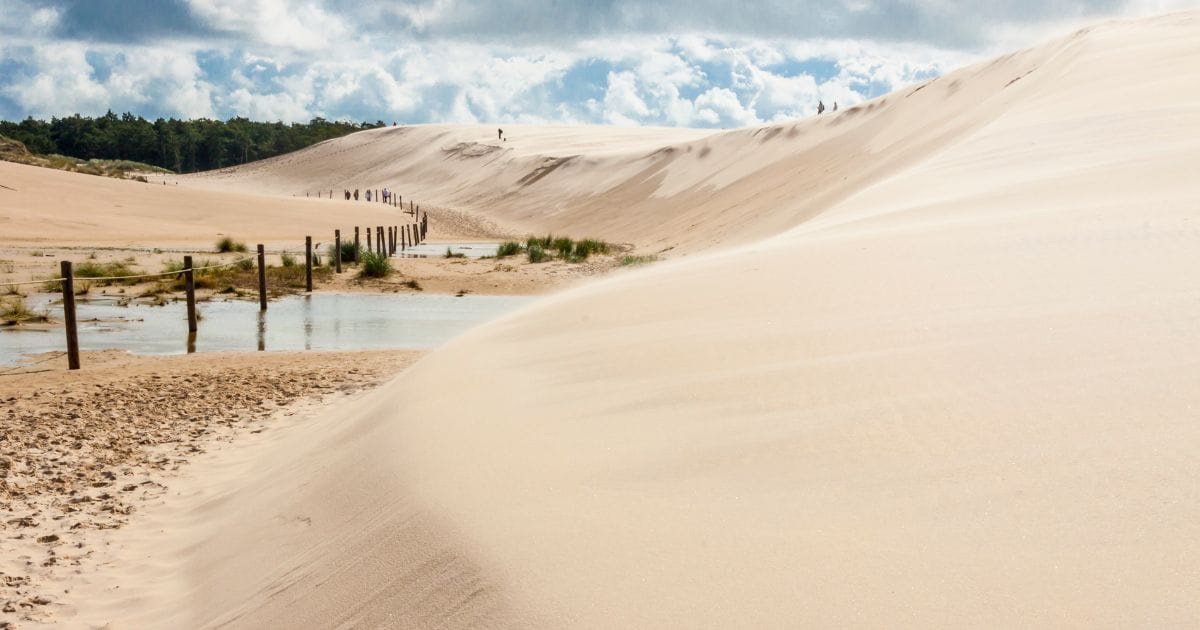
Do you want to feel like you are on an exotic holiday in the desert in Poland? Who would have thought that just a few kilometers west of the resort of Łeba is the Słowiński National Park, one of the most interesting places on the entire Polish coast. The biggest attraction here are the giant sand moving dunes, which the wind keeps moving. They reach a height of up to 40 meters and create a fascinating contrast with the surrounding pine forests, lakes and wetlands. 

Tip: 27 destinations where in May to the sea in Europe

pouštní duny

Camping Rafael – Łeba

Camping Rafael is located in a great location right by the Łeba River and just a few minutes’ walk from the Baltic beach. It offers a wide selection of accommodation: from tent and caravan sites to wooden houses, mobile homes, rooms and apartments. The area is cozy and surrounded by greenery, there is a small harbor for boats on the river, a bicycle rental, a children’s playground, table tennis and a windsurfing and kitesurfing school. Fishing is also available. the campsite is open year round, so it is also suitable for spring or autumn trips.

Tip: The colder sea and windy is not only by the sea in Poland, but also on the island of Fuerteventura in the Canary Islands, where we have selected for you 30 great places to see at Fuerteventura.

Camping Leśny – Mrzeżyno

Are you looking for Polish campsites by the sea, where there is peace and quiet? Then drive to Camping Leśna. The beach is only about 300 m away, which is not very crowded and overall the surroundings are very quiet, suitable for relaxation. At the campsite you can find a kitchen, sanitary facilities and a bicycle rental. This camp is  great For older couples, cyclists or travelers, who want to enjoy a quiet holiday close to nature.

Camping Nr. 24 Relax – Pobierowo

It is located in the picturesque seaside town of Pobierowo Camp Relax, just a few tens of meters from a beautiful sandy beach. The campsite equipment is at a very good level and Pobierowo itself is Popular thanks to the pine forests and the clear sea. The surroundings are suitable for hiking and cycling. 

Camping Kormoran – USTKA

Camping Kormoran It is a smaller but very cozy campsite near the center of the popular resort of Ustka. Thanks to You can walk to the beach in a few minutes, So to the historic center with a port, lighthouse and restaurants.

Tip: 23 great places to go to the sea in Europe in April

How to best enjoy Polish campsites by the sea 

Whether you are going to camp somewhere in the mountains or are excited by Polish campsites by the sea, we have a few tips for you on how to save on the spot and how to enjoy the best time.

  • Book early: In the summer months, the campsites are quickly occupied, especially those in popular locations such as Hel or Międzyzdroje.
  • Take your bike: Most of the campsites are located near the bike paths, and riding along the coast is a wonderful experience.
  • Beware of windy weather: It can be windy in the Baltic Sea area, a solid tent and quality anchoring are recommended. Don’t forget a wall to the beach, so it doesn’t blow you away.
  • Check camping equipment: Not all campsites have restaurants or shops, so it is a good idea to find out in advance what the area has to offer. Also pack a proper snack.
  • Cash and card: Most campsites accept payment cards, but in smaller municipalities it can also be advantageous to have cash.
  • Get ready for cooler evenings: Even in summer, nights at the Baltic can be cold, warm clothes are suitable.

Tip: Fuerteventura Review: Tips, Experience and What You Should Know Before Your Trip

Frequently Asked Questions (FAQ)

Kde kempovat v Polsku u moře?

V Polsku najdete přes 360 kempů u Baltského moře, které nabízejí různé možnosti ubytování a rekreace. Mezi oblíbené kempy patří:
Ustronie Morskie – Camping „Pod Brzozami“
Klidné místo obklopené břízami, ideální pro rodiny i páry.
Uciechów – Camping Forteca
Kemp s příjemnou atmosférou, vhodný pro milovníky přírody.
Łeba – CAMP na wydmie (Kemp na duně)
Nachází se přímo na písčitých dunách, ideální pro dobrodružné typy.
Chłapowo – Camping Alexa
Kemp s moderním zázemím a blízkostí pláže.
Kołczewo – Camping Tramp
Klidné prostředí v blízkosti přírodních rezervací.
Darłowo – Fly Resort Kopań
Skvělé místo pro ty, kdo hledají kombinaci pláže a vodních sportů.

Kolik stojí kemp v Polsku?

Cena za noc v polském kempu u moře se pohybuje kolem 27 eur, ale může kolísat v závislosti na sezóně a vybavení kempu. V hlavní turistické sezóně jsou ceny vyšší, ale mimo sezónu najdete i levnější možnosti. Některé kempy navíc účtují příplatky za elektřinu nebo další služby.

Kam jet do Polska k moři?

Nejkrásnější pláže Polska nabízejí rozmanité zážitky:
Świnoujście – „Mallorca severu“ s širokými plážemi a příjemnou atmosférou.
Kolobřeh – největší letovisko s bohatým nočním životem.
Trzęsacz – malebná vesnička s útesy a starobylými ruinami.
Ustka – známá jako ráj pro sběratele jantaru.
Jarosławiec – přezdívaná „pláž Dubaj“ díky své rozloze a písku.
Sopoty – elegantní město s promenádou a písečnými plážemi.
Gdaňsk – pláž Stogi – kombinace historie a přírody.
Łeba – dlouhé pláže a unikátní pohyblivé písečné duny.

Kde je v Polsku nejteplejší moře?

Nejteplejší voda u polského pobřeží bývá zpravidla na severozápadě u ostrova Wolin a ve městě Świnoujście. V létě se zde teploty mořské vody často dostávají až k příjemným 20 °C. I tady ale často fouká vítr, který může chladit vzduch.

Kdy do Polska k moři?

Sezóna u Baltského moře začíná v červnu, ale ideální počasí na koupání většinou přichází až od poloviny července do konce srpna. V těchto měsících je moře nejteplejší a počasí bývá nejstabilnější.

Kde přespat v Polsku v autě?

Nocování v autě mimo vyhrazená místa je v Polsku tolerováno víc než v jiných zemích, ale je potřeba být opatrný, zejména ohledně soukromých pozemků nebo chráněných oblastí. Nejlepší je využít oficiální parkoviště a kempy, kde je noční pobyt povolen.

Jak daleko je Polské moře?

Nejbližší moře k České republice je v Polsku v oblasti Štětínského zálivu. Z hranic ČR do této oblasti je to zhruba 300 km, což je v porovnání s jinými mořskými destinacemi poměrně blízko.

Kam nejblíže k moři autem?

Nejkratší vzdušná vzdálenost z ČR k moři vede ze Šluknovského výběžku k Štětínskému zálivu a měří asi 283 km. Po silnici je to zhruba 430 km, což představuje přibližně pět hodin jízdy autem.

Colombian cuisine: 22 tips for traditional food in Colombia

Kolumbijská kuchyně – 22 Tipů na tradiční kolumbijské jídlo

Colombia is said to be one of the most colorful countries on Earth. Some may find it too cheesy when everything is so colorful, but Colombians just like it that way. Colombian cuisine, which we knew nothing about before the trip, is just as varied. I’m not going to lie to you, I didn’t like dry pork skins, hooves or drinks with salt. I lost five kilos in five weeks, but I still liked a lot of food there. What did we like best in Colombia?

What makes Colombian cuisine so diverse

Colombia is a land of contrasts – from tropical coasts to high Andes. Each region offers its own specialties, from the traditional Bogota dish – Ajiaco, to fish delicacies with coconut milk from the Caribbean coast and Cartagena. In short, you will come across new and unique tastes in every part of the country. In the mountainous regions, meat and potatoes dominate, while on the coast you can enjoy fresh seafood and fish. And the fruit? You will taste goodies that you didn’t even know existed (literally).

Colombian Cuisine - Empanadas
Colombian Cuisine – Empanadas

Tip: 15 tips for the most beautiful places in Colombia, where you will feel like you are on another planet

22 tips for traditional Colombian foods

Colombian cuisine was really interesting and, as the saying goes, ‘like a Spanish village’ to us. I appreciated fresh fish, exotic fruits and fruit smoothies the most And also all kinds of food from green bananas (plantains). Try what you can, because you won’t find such foods here.

  1. Ajiaco – Chicken soup with three types of potatoes, corn and sour cream will warm your body and soul. Since we arrived a little bit sick from the air conditioner after 50 hours of travel, this soup came in handy upon arrival. Even though it reminds me of a soup and main course combined, it tastes really great.
  2. Bandeja Paisa – If there is one dish that defines Colombia, it is Bandeja Paisa. it is a plate with a little bit of each. You will find meat, beans, rice, avocado, eggs and other goodies on it. 
Colombian cuisine - Bandeja Paisa
Colombian cuisine – Bandeja Paisa
  1. Lechon – Would you like a slow-roasted pig filled with rice and spices? It might sound weird, but it’s completely normal here.
  2. Morcilla Rellena – If you think the intestines can’t be a culinary experience, Morcilla Rellena will mislead you. This delicacy, grilled or fried until crispy, is full of flavors. So if there are any gourmets here, you can try it.
  3. Empanadas – Colombian empanadas are fried until golden and filled with meat, cheese or potatoes. We ate them for breakfast, lunch and dinner. You can buy them on every corner and I believe that Everyone will really like this dish.
  4. Pandebono – Cornmeal, cheese and eggs bread is eaten immediately after taking it out of the oven when it is still warm and soft. 
  5. Patacones – Patacones, also known as Tostones, are crispy patties made from sycamores. These patties are fried twice – the first time for softness, the second time for crunchiness. You will most often get them as one of the side dishes for the main course, but you can also enjoy them as a snack.
  6. Tamales A tamal is a dish wrapped in a banana leaf in which you can find corn dough filled with chicken, vegetables and spices, which are cooked slowly to make the flavors blend perfectly. Each region has its own option. I really fell in love with this dish. Although it looked strange, the taste was divine.
Colombian cuisine - Tamales
Colombian cuisine – Tamales
  1. Arepa – A simple corn patty that you can eat both sweet and salty. Arepa is eaten in Colombia the same way as a bread in our country. If you come across a local ‘bakery’, take a few of them to stock up on. But we won’t lie to you, somewhere they tasted like a rubber sole, but in the local bakeries it was something delicious.
  2. Cazuela de Mariscos – Seafood in creamy coconut broth, that’s Cazuela de Mariscos. It is a soup full of shrimp, crabs and fish and is served with a portion of rice. 
  3. Chocolate con queso – Colombians like to mix strange tastes, so you can have hot chocolate with cheese. Yeah, you read that right. In addition, they also add the goat cheese to hot tea. I didn’t really like it, but it’s something that everyone probably has to try for themselves.
  4. Patacones with Hogao – Crispy fried banana patties, topped with Hogao tomato, onion and coriander sauce.
  5. Frijoles Rancheros – a dish made of red beans, which may resemble our bean stew, but it tastes really good. Somewhere it can be served with meat, rice, or perhaps with fried bananas on top. I highly recommend it!
Colombian cuisine - Frijoles Rancheros
Colombian cuisine – Frijoles Rancheros
  1. Ajiaco santafereño – a typical soup made of Bogotá, which combines chicken meat, corn cobs, potatoes and unique guasca spices. Served with avocado, capers and rice.
  2. Chicharron Con Arepa – Crispy fried pork skin placed on a soft arep. The locals especially like it, but when I tried Chicharron, I’d say it’s a treat for the dog.
  3. Arroz Con Chivo – Goat meat stewed with rice and vegetables, often served with avocado and fried bananas. 
  4. Mute – Seasoned stewed meat with beef, chicken or pork in a spicy sauce. Served with beans and rice.
  5. Sancocho de Pescado A fish soup that is often served on the northern coast of Colombia. 
  6. Arroz Con Coco – rice cooked in coconut milk with onions, garlic and coriander. It is served with chicken or fish. You can also come across it in the sweet version, which is eaten as a dessert.
  7. Carne Oreada – beef marinated with onions, tomatoes and coriander, grilled until tender. 
  8. La Picada – A mix of meat, potatoes and vegetables served with arepas. 
  9. La Changua – Milk soup with cheese and poached eggs, typical breakfast in Bogotá. It is served with crispy bread.

PS: For a snack at Laguna de Guatavita, we got a slice of goat cheese with sweet gelatin that resembled marmalade. We tried it, but it tasted really weird.

What is drunk in Colombia

I have a lot of friends from abroad and everyone is surprised that beer is so cheap in our country (a few years ago, paradoxically, cheaper than water). It is no wonder that we are a nation of beer drinkers. They do have beer in Colombia, but they prefer something else.

  • Aguardiente – You can buy sugar cane schnapps with an anise flavor, which is sold in a cardboard box as milk, on every corner. It has a distinct taste and several variants according to the alcohol content. No matter what you eat, it’s a nice headache in the morning.
  • Chicha – a fermented drink of the original inhabitants of the Andes, has a tradition dating back to ancient times. It is mostly made from corn, sometimes from fruit. It has a slightly sour taste, yet it tastes very good. Just don’t drink it too much so that it doesn’t have a laxative effect on you. 
  • Agua panela – Do you know the panel? It is a dried cane juice that is used as a sweetener and as a popular drink when it is dissolved in hot water. It’s pretty good, but very sweet.

TIP: Are you going to visit Medellín and Comuna 13? We will advise you 17 tips to see, where to stay and what to watch out for in Medellín.

Colombian Cuisine - Chicha
Colombian Cuisine – Chicha

Fruit smoothies for a few crowns

What surprised me was that in almost every establishment, they made homemade fruit smoothies, which cost just a few pesos there. I liked the smoothies from Mango or Maracuja the most, but there were really a lot to choose from. They just like to add sugar to it, so don’t forget to say ‘Sin Azúcar’!

TIP: Are you looking forward to Colombia for real Colombian coffee? You can visit some coffee plantations, most of which are around the town Salento, where there are also the tallest palm trees in the world.

Where to have a good BBC beer – Bogota Beer Company

If you are one of those who simply like to have a smooth beer or two on vacation or on the go, don’t worry. There is a BBC franchise or Bogota Beer Company in Colombia where you can have a really good draft beer (mostly there are bottles everywhere). But also expect that it will be more expensive (relatively to other prices). One beer there cost us around 2,5 EUR for 0.5 l. 

Tip: What is the capital of Colombia? 13 interesting places in Bogotá

Where and how to eat as a local

If you are in tourist areas or larger cities, restaurants and businesses will be at every turn. You might not recognize the places where the locals eat at first glance. Our friends from Colombia were often with us, who took us to places that I would call a garage, a backyard in the garden or simply someone’s kitchen at home, and it was usually a real experience. The food there was for a fraction of the price (soup, main meal and drink for 2 EUR), but I don’t want to lie to you, we didn’t always like the food.

If you also want to eat where locals do, look for sunken small kitchens and businesses, stalls or bakeries where local people go (Or try to ask them, they will be happy to advise you). But don’t expect any luxury, menu or list of allergens.

Colombian cuisine - local food
Colombian cuisine – local food

Tip:13 things to take on a plane for a long flight

What are the prices of food in Colombia

Prices are constantly rising in all countries. It depends on whether you will eat in someone’s backyard on a wooden log in the countryside, or if you will be in a beautiful restaurant in the middle of the big city. But it is true that you can eat well in Colombia and for a few euros. In tourist areas, you will pay 18,000 to 30,000 COP per meal (depending on what you eat, but steak or fresh fish are more expensive than a bowl of rice). Where the locals eat, you can easily pay 10,000 COP for the entire menu. 

TIP: One of the most beautiful places in Colombia is definitely Tayrona National Park. You can find everything you need to know in our complete article.

Colombia’s national food

There can be many national dishes in Colombia, because each area has its own. One of them can be the just-mentioned food Bandeja Paisa, which comes from the Antioquia region. It’s a food where you have a lot on your plate and don’t know what to eat first. There you will find beans, fried plantains, chorizo, arep, avocado and rice. JAs a national soup, sancocho, which is cooked from meat and then served with rice and avocado or other vegetables, could be considered national.

  • Breakfast It tends to be simple, but nutritious. Typical are arepas (corn pancakes) with cheese, eggs or avocado, often supplemented with a cup of sweet coffee. In some areas, people eat caldo – beef or chicken broth. Otherwise, they also normally have soup for breakfast, which is not exactly common for us.
  • Lunch It is hearty and, like ours, includes soup and a main course. Common are foods like Sancocho (meat and vegetable soup), Bandeja Paisa or Ajiaco. As a side dish, it is most often rice, a small portion of beans or a crispy plantain.
  • Dinner It tends to be lighter. Many Colombians have, for example, tamales, soup or arepa with various fillings. 
Colombian cuisine - Ajiaco soup
Colombian cuisine – Ajiaco soup

The conclusion and what we really liked

For me, discovering new cuisines and flavors is definitely a part of traveling. I like to try all kinds of food, even if I don’t always like everything. Colombian cuisine is really rich. I liked these foods the most: Tamales, Frijoles Rancheros, Bandeja Paisa, Empanadas and especially fresh fish and fruit.

Tip: What security does Colombia have and 6 tips on what (not) to do in Colombia

FAQ

Is Colombian food suitable for vegetarians?

I’m sure it is. While Colombian cuisine includes plenty of meat dishes, it also has a wide selection of vegetarian options. Popular vegetarian Colombian dishes include traditional arepas, which are eaten with perhaps everything, tamales or empanadas in many ways.

What is a typical food in Colombia?

Colombia is a big country and every part of the country has its favourite foods that are a bit different from each other. The main and universal traditional dish in Colombia is the bandeja paisa, which is a plate that has a little bit of everything on it. You’ll find a bit of meat, rice, beans, avocado, crispy bananas and other side dishes depending on the location. Corn fritters arepas are also eaten all over the country.

Resources

Osorio, D.G., 2020. Traditional Colombian Cuisines Objects and Ritual. Projetica, 11(3es.), pp.166-182.

Mahecha, J.D., 2015. Forms of Colombian Cuisine: Interpretation of Traditional Culinary Knowledge in Three Cultural Settings. Cooking Technology: Transformations in Culinary Practice in Mexico and Latin America, p.153.

Mahecha, J., 2017. A New Culinary Culture in Colombia: Equality and Identity in the Interpretation of Traditional Cuisines.

The Capital of Colombia Bogota: 13 Tips to See in and Surroundings

Hlavní město Kolumbie Bogota

Everyone who is going to Colombia will probably fly to Bogota. Although Colombia attracts travelers mainly with nature, the rainforests and the Caribbean, If you have a few days to spare, there is a lot that the capital city of Colombia Bogota has to offer. We were so fascinated by Bogota that we spent 9 days here with our local friends, who showed us secluded places in the vicinity that we probably would never have discovered without them. We have 13 interesting places for you to see in Bogota and its surroundings.

What should you think about when planning a trip to Bogota

Before we explore together what the capital of Colombia, Bogota and other cities are like, we have some practical information for you to start with.

What is security in Bogota

Everyone who is going to Colombia is probably interested in the issue of security in Colombia. It is different in different parts of this country, but in general, it is less safe in big cities than somewhere in nature, and the city center is often a center of higher crime. Therefore, it is always best to consult, for example, in accommodation, which places to avoid. And if you don’t have someone local with you, better not to wander anywhere at night. What to watch out for?

  • Don’t carry more money with you,
  • Keep money in multiple places,
  • Do not carry with you any expensive things that could attract attention,
  • Stick to places where there are a lot of people,
  • Do not withdraw money from ATMs on the street (withdraw from those that are inside buildings and shopping centers),
  • If you have a backpack, watch out for it,
  • Try to blend in with the locals.

Tip: What security does Colombia have: 6 tips on what to (not) do in Colombia

Colombia Capital Bogota - Security in Bogota
The capital of Colombia Bogota – Security in Bogota

TIP: What security does Colombia have and tips to watch out for

When to go to Bogotá

Although Bogota will probably not be the only destination of your trip to Colombia, it is good to know that Bogota is located at a higher altitude and although this area may be considered a tropical climate, it is The weather in Bogota is quite unstable. The most precipitation here rains from about the month of April to July, while it is quite dry here from December to March, so this range is the best time to visit. But definitely pack a waterproof jacket, it will probably come in handy in the city as well.

TIP: How about visiting the famous drugMedellin or a colonial cityCartagena de IndiasOn the Caribbean coast?

Transportation in Bogotá

We warn you in advance that Traffic in Bogotá and throughout the country seems incredible to you. We definitely do not recommend renting a car here. The fastest way to get around the city is the Transmilenio buses, which have their own lane all over the city, which you will really appreciate, Because otherwise there are traffic jams everywhere and always (for example, we stood in traffic at 3 in the morning because of it and missed the plane).

TIP: Are you already packing your bags for Colombia? With a backpack on our backs, we wandered across the country for over a month and chose 15 most beautiful places to see in Colombia.

The capital of Colombia Bogota and 12 places to see in and around Bogotá

Do you have a few days in Bogotá and want to use them to the fullest? I believe that our tips on what to see in Bogota and the surrounding area will inspire you. I think 2 days are enough for you in the city itself, but there is really a lot in the area. From waterfalls, national parks, picturesque villages to the legacy of drug cartels. Everyone will find something for themselves. In Bogotá, we liked the climb to Monserrate and the historic district of La Candelaria the most. From the surroundings then Villa de Leyva, Laguna de Guatavita and Nimaima.

The capital of Colombia Bogota - What to see in and around Bogota
The capital of Colombia Bogota – What to see in and around Bogota

1. La Candelaria Quarter and Bogota’s Historic Heart

Every traveler will probably delve into the historic center. The capital of Colombia, Bogota, really offers a lot, so it If you want to start your adventure in Bogotá, the historic district of La Candelaria is the right place. This picturesque neighborhood, located in the very center of the city, represents An authentic piece of Colombian history and culture. Narrow cobbled streets, traditional houses with wooden balconies and colorfully painted facades create an atmosphere that will instantly absorb you. 

2. Plaza de Bolívar Square

In the La Candelaria district there is also the main square Plaza de Bolívar. In the square you will see beautiful colonial buildings, in addition, you can take a picture with the llama, feed the pigeons and eat something good. The square was originally known as Plaza Mayor and from 1821 was named Plaza de la Constitución. 

It is located on the northern edge of the square Palace of Justice, while the Southern side is framed by the National Capitol, the seat of the Colombian Congress. The mayor’s palace (Palacio Liévano), built between 1902 and 1905, is located on the west side. On the eastern side, the primary Bogotá Cathedral, which was built at the beginning of the 19th century, dominates.

3. Botero Museum – Bizarre on canvas

Do you like bizarre? There is no art like art and I am convinced that you have never seen anything like this before. The Botero Museum exhibits the works of the famous Colombian painter Fernando Boter, who is known for his unique ‘boterismo’ style, depicting excessively round figures and shapes. In addition to his works, you will also find works by world masters such as Picasso, Dalí or Monet. Moreover it is Free admission to the museum, so you can at least take a look.

Colombia's capital Bogota - Botero Museum
The capital of Colombia Bogota – Botero Museum

 4. Parque Metropolitano Simón Bolívar

Parque Metropolitano Simón Bolívar is one of the largest and most important public parks in Bogota, spread over more than 400 hectares in the very heart of the city. This vast park complex is often compared to New York’s Central Park and acts as the ‘green lungs’ of the Colombian capital. In addition, it is located on the western edge of the park Botanical Garden José Celestino Mutis. So if you want to be closer to nature again for a while, you can have a picnic or a walk in the park.

TIP: Are you attracted to nature? Then definitely go explore the Caribbean beaches in conjunction with the rainforest inTayrona National Park.

5. Cerro de Monserrate viewpoint (3152 m)

What we liked the most in Bogotá was a smaller hike to the viewpoint on Mount Monserrate, which is part of the eastern Kordillery Mountains and which you can easily walk to from the city. Since the city of Bogota is at a fairly high altitude, even a small hike gave us quite a bit of work and we were out of breath, but it’s certainly not a thing that no one can handle. At the top you will see hummingbirds, a chapel, a basilica and wonderful views of the whole city. Be sure to go out sometime during the day to get back in the light and not wander around the hills in the dark.

The capital of Colombia Bogota - Cerro de Monserate
The capital of Colombia Bogota – Cerro de Monserate

6. Gold Museum in Bogotá

The Gold Museum in Bogotá is one of the most visited tourist spots in Colombia. Since gold is an inherent part of this area and is a significant part of history, it’s quite nice to go here if you have some time. There you will see collections of pre-Columbian gold artifacts and various metal alloys, including Tumbaga, which were sacred to the original cultures. 

What other museums in Bogota can you visit

Like other capitals, Bogota has many museums with different focuses that you can visit.

  • Museo Santa Clara with Baroque art,
  • Museo Historico de la Policia (Historical Police Museum),
  • Museo Nacional (Colombian National Museum),
  • Scientific Museum of Maloky.

Tip: You will most likely visit Bogota either way. If you have a few days to spare, we have 13 tips for great places,What to see in and around Bogotá.

7. Villa de Leyva – a picturesque colonial village

About a 3-4 hour drive from Bogota lies Villa de Leyva, one of the most beautifully preserved colonial cities in Colombia. This picturesque city transports you back to the 16th century Thanks to its cobbled streets, white facades of houses and the largest square in Colombia, Plaza Mayor. Don’t miss the Casa Terracota Museum, a unique ceramic building that resembles a clay palace.

We recommend staying here overnight, so that you can really soak up the local calm atmosphere after sunset and discover the surrounding natural beauty, such as El Fosil, where you can see the preserved fossils of prehistoric creatures.

8. Laguna de Guatavita – Legendary El Dorado Lake full of gold

If you want to fall out of the big city into nature for a while, we recommend the nature reserve and Lake Laguna de Guatavita, which is considered the place of origin of the legend of El Dorado. This circular lake, hidden among the green hills, is the place where the native chiefs performed golden ceremonies and threw the treasures into the water as sacrifices to the gods. 

The journey by car takes about 1.5 hours from Bogota. The entrance fee includes a guided tour (only in Spanish, but it’s still worth it), which will introduce you to the history and legends associated with this place. We really liked the tour of the reservation and we are glad that we went there, even though we didn’t really understand them, because otherwise we wouldn’t be able to get to such places at all.

The capital of Colombia Bogota - Laguna de Guatavita
The capital of Colombia Bogota – Laguna de Guatavita

What the Legend of El Dorad tells

The legend of El Dorad tells about a golden city that was supposed to be hidden somewhere in the South American mountains. According to the original version from the Muisc SE tribe At the coronation of the new ruler, he performed a ritual on Lake Guatavita: the monarch covered himself with gold dust, rode the raft into the center of the lake and offered gold and gems to the gods. The Spanish conquistadors interpreted this legend as the existence of a rich city full of gold. This triggered a feverish search that lasted for centuries but The mythical city has never been found.

9. Catedral de Sal V Zipaquirá – underground salt cathedral in the mine

An hour’s drive from Bogota is the Catedral de Sal salt cathedral in Zipaquirá, located in the salt mine. The cathedral is carved into the former salt mine and is located 180 meters underground, where it was created as a place for miners’ prayers, who needed protection from danger.

The total area exceeds 8,500 m². It is carved from huge walls and tunnels and consists of several chapels, statues and altars, all made of rock salt. Visitors walk the Way of the Cross, which depicts the 14 stops of Christ’s suffering, when it arrives at the main hall of the cathedral, in which it is great Salt Cross – one of the largest of its kind in the world.

It’s such an unconventional place that you probably wouldn’t think of going, but we really liked it. At the entrance, you’ll receive an audio guide (thankfully, it’s also in English) and you go through the entire mine at your own pace.

TIP: And what is it like Colombian cuisine? 22 tips for traditional food in Colombia

Emerald Tour

The tour of the salt cathedral also includes an exhibition of all kinds of emeralds, which were already mined by indigenous tribes before colonization. Colombia is still one of the largest producers of emeralds in the world, and the three main areas of mining include Muzo, Coscuez and Chivor. We were completely captivated by the Emerald Exhibition, because there are really unique pieces that you just don’t see anywhere.

10. Pacho Village and Drug Cartels Legacy

Are you interested in the history of drug cartels? Then The village of Pacho, located about 80 km from Bogotá, might surprise you. In the 1980s, it was the center of operations for José Gonzalo Rodríguez Gach, one of the most powerful drug lords of the Medellin cartel. You may have already heard of him by nickname ‘El Mexicano’. He had farms and ranches in the smell, which they used to produce and distribute cocaine. The city and its surroundings were under his control and, thanks to his influence, became a key point for the drug trade in the region.

The capital of Colombia Bogota - the village of Pacho
The capital of Colombia Bogota – the village of Pacho

What you can see there today

We went to the village with our Colombian friend. We went through the whole ranch, farms And part of the village and it felt a bit like a ghost town. We talked there with the local people, who told us that, for example, they helped out at the ranch as children, and we also learned interesting things about this place. Everyone knows Pablo Escobar, but he was far from the only drug lord in Colombia. That’s why you can see in the village of Pacho behind the scenes and the environment of the drug trade, but without tourism, which is needed in Medellin.

11. Parque Natural Chicaque

If you love nature and hiking, visit Chicaque Nature Park, which is located about 30 km from Bogota. This natural paradise offers more than 20 km of hiking trails that will take you through dense foggy forests, waterfalls and rocky viewpoints. You will see here not only beautiful nature, but also a lot of animals. Inside the park you will also find an ecological farm.

12. Nimaima and the Center for Adrenaline Activities in Nature

If you are an adventurer in body and soul like us, Nimaima is a place that is guaranteed to excite you! Nimaima is a beautiful place in the middle of nature, in which there are adrenaline activities of daily bread. Forget the hustle and bustle of the big city and go to Wild trails that lead through fresh jungle and deep canyons. The Río Negro is ideal for those who have the courage to tame its currents while rafting, or to plunge from it into the depths during canoeing. There are a lot to choose from here.

Rafting on Río Negro

Our friend prepared a surprise for us in the form of rafting. Since we both go on the water here in the Czech Republic, we really liked the idea. The Río Negro truly lives up to its name, due to the unique bedrock, minerals seep into the water, giving the river its distinct black color. When going down the river was quite wild and No one told us that their goal was not to conquer the rapids, but to take a bath, because it was the fun. 

So I flipped right behind the first rapids and couldn’t climb back into the boat. If I had known, I would have arranged additional insurance for extreme sports, because I had soaked my water so much that I was afraid that something would be made of the dirty water. Anyway, it was a really lively trip and I believe that the adrenaline enthusiasts will find something here.

Tip: Did you know that Colombia also has the tallest palm trees in the world, the best coffee and also a lot of hummingbirds? You can see everything in the mountain the village of Salento, which is full of colors and an incredibly amazing atmosphere.

13. La Chorrera – Colombia’s highest waterfall

Are you attracted by nature and waterfalls? Then head to the highest waterfall in all of Colombia  La Chorrera. Only 45 minutes by bus and you will find yourself at the beginning of the trail. A roughly three-hour walk through the beautiful landscape of foggy forests, pastures and narrow paths awaits you. At the end, you will be rewarded with a view of the water falling from a height of almost 600 meters. On the way back, you can still jump to the smaller El Chiflon waterfall, where you will pass directly behind the water wall. 

The capital of Colombia Bogota - La Chorrera
The capital of Colombia Bogota – La Chorrera

A little bit of Bogota’s history

The capital of Colombia, Bogota, has a fascinating history that dates back to the time of pre-Columbian civilizations. The area was originally inhabited by the Muisci tribe, who flourished here thanks to rich gold reserves and trade routes. In 1538, the Spanish Conqueror arrived in the area Gonzalo Jiménez de Quesada, who founded the city of Santa Fé de Bogotá here.

During the colonial era, Bogotá became an important cultural and political center of the Spanish Empire in South America. In 1810, the struggle for independence began here, which led Simón Bolívar to the liberation of Colombia (after which it is also the name of the main square). Since then, Bogotá has grown and transformed into a modern metropolis, despite facing challenges such as political instability and violence associated with drug cartels in the 20th century.

Where did we also like it

We experienced another adventure, where we flew halfway around the world with a one-way ticket Sri Lanka, which completely captivated us. We wandered around for a month beaches in Sri Lanka, discovered local cuisine, nature, traveled to the center of the island tea plantations or Lion’s Mount Sigiriya. So if you don’t know where to go, we recommend all twenty!

FAQ

Na co si dát pozor v Kolumbii?

Při cestování po Kolumbii doporučujeme obezřetnost, zejména pokud se plánujete pohybovat po setmění. Vyhněte se nočním jízdám autem či autobusem. Ve větších městech je kriminalita vyšší, proto se nikde netoulejte po nocích a vždy si zjistěte (třeba v ubytování nebo na internetu), které městské části jsou bezpečné a které ne.

Kdy navštívit Kolumbii?

Aby vaše dovolená v Kolumbii byla co nejlepší a nepřekvapilo vás třeba počasí, jeďte od prosince do února, kdy je zde nejsušší počasí. Také měsíce říjen, listopad, březen a duben jsou skvělou volbou, protože zde není tolik turistů. Uvědomte si ale, že klima se v jednotlivých regionech značně liší, a tak zatímco v Bogotě může být příjemně chladno, v Karibiku vás čekají tropická vedra.

Co je to Bogota?

Hlavní město Kolumbie je Bogota v Jižní Americe. Zajímavostí je, že se nachází v nadmořské výšce 2 640 m. Město založil v roce 1538 španělský dobyvatel Gonzalo Jiménez de Quesada. Srdcem historické části města je čtvrť La Candelaria, kde najdete krásné koloniální budovy a barokní architekturu, muzea, malebné barevné domečky, street art a spoustu krásných zákoutí.

Co vidět v Bogotě?

Pokud nevíte, co vidět v Bogotě, zajděte do historické části města La Candelaria, ve které se nachází koloniální budovy, spoustu muzeí, náměstí Plaza de Bolívar a mnoho krásných zákoutí. Oblíbená je také hora Monserrate, na kterou si můžete udělat výlet buď pěšky, nebo lanovkou a užít si výhledy na celou Bogotu.

Co vidět v okolí Bogoty?

V okolí Bogoty je spoustu zajímavých míst, která rozhodně stojí za návštěvu. Nám se nejvíce líbila důlní katedrála v solném dole, výlet za lagunou La Guatavita, Villa de Leyva a oblast Nimaima, kde si můžete užít adrenalinové sporty.

Resources

Bellón, E.R. and González, L.G., 2014. Tourism in Colombia. In tourism as an instrument for development: a theoretical and practical study (Vol. 5, pp. 211-226). Emerald Group Publishing Limited.

Mohan, R., 1980. The People of Bogota: Who They Are, What They Earn, Where They Live. In the People of Bogota: Who They Are, What They Earn, Where They Live (pp. 153-153).

Rueda Esteban, n.r., 2017. Is the tourist management important for the religious heritage in bogota?.

Ochoa, L., 2004. Cosas Viejas de la Villa de la Candelaria (vol. 15). itm.

Gómez Ortiz, S.J. And González Jiménez, J.A., 2019. Turismo en Bogotá.

What is Colombia security like: 6 tips on what (not) to do in Colombia

Kolumbie bezpečnost

We are most attracted by countries where not many travelers travel to. One such country is Colombia, our favorite destination, which is full of colonial cities, rainforests, and Caribbean beaches. Although Colombia is an amazing country, it struggles with poverty, which is reflected in its crime rate. Unfortunately, assaults, thefts, and robberies are common occurrences in Colombia. That’s We’ve put together some tips and 6 safety rules to help you stay safe in Colombia. What is the safety of Colombia?

Did we feel safe in Colombia?

People often asked us about the safety situation in Colombia and if it was a safe destination. It was fine for us and we didn’t have any bad experiences, but of course that doesn’t mean that nothing can happen to anyone. It is necessary to follow certain rules, To avoid possible complications.

Travelers are especially drawn to Colombia’s beautiful nature, the azure Caribbean Sea, the high mountains, and the friendly local population. As Colombia becomes more open to tourists, it is striving to improve visitor safety. That’s why you’ll also come across police officers on every corner.

Tip: 15 most beautiful places in all of Colombia, which are like from another planet

Dark History of Colombia

The dangers that each of us imagine are probably armed robberies, thefts and violence. Unfortunately, these are still possible in certain areas in Colombia. Please note that the war between the drug cartels only ended in 2012. Many locals own guns. We also wandered in Medellín to places I would definitely not want to return to and tourists should avoid them.

Colombia - Security - Medellin
Colombia security – Medellin

When we were afraid

In the whole 5 weeks we had no major problems. Of course they wanted to rob us several times (for example, they didn’t give us the right one or they gave us higher prices and once someone stuck to us from behind and wanted to steal a backpack) but except for one moment we always felt safe.

That moment was in Medellín when we were walking through a street filled with garbage, and we saw people lying on the ground, and we weren’t sure if they were still alive. All around was a huge street market for all kinds of stolen goods and drugs. The smell of dead (perhaps) animals was omnipresent. At that moment, we were only thinking about how to get out of there as quickly as possible.

Anyone who has visited South America without incident will likely tell you that it’s a safe destination. However, those who have been robbed often have a different perspective. Understand that risk is always present, and what we can do is prepare ourselves.

Tip: 17 places to see in Medellín and what to watch out for

What is the security like in Colombia

Whether a country is safe can be divided according to natural, cultural or health risks. Therefore, let’s see what risks are at stake in Colombia.

Health and health risks

In our country, healthcare is widely available, but in Colombia, it varies depending on the location. While there are hospitals in big cities, they often lack modern equipment and facilities. In the countryside and in small villages, it is a bit worse, mainly with the availability of medicines in pharmacies, etc. Therefore, get everything you need, for example, after your arrival in Bogotá.

Mosquitoes are the primary carriers of diseases in Colombia, and they can transmit diseases like dengue, Zika, and chikungunya fever. Protect yourself with an effective repellent (ideally purchased in Colombia, as some repellents may not be as effective) and wear bright, long clothes.

Tip: Vaccination is not mandatory, but it is recommended to get vaccinated against yellow fever, jaundice, typhoid and tetanus. It is now possible to get vaccinated even for Dengue fever!

Colombia - Safety - Vaccination
Colombia Security – Vaccination

Colombia’s natural disasters

Of the natural disasters in Colombia, you have the best chance of encountering earthquakes that form together with volcanic eruptions. Northern Colombia can sometimes be hit by extreme drought, which can also occur in tourist areas or, on the contrary, landslides during heavy rains. At the same time, it is certain in the north off the coast of the Caribbean Hurricane risk.

ATTENTION: Also watch out for the beaches where you are going to swim. Many of them are on Strong sea currents that can carry you far to the sea. These are mainly beaches in Tayrona National Park, which are unguarded.

Crime in Colombia

Crime in Colombia is probably the most dangerous aspect you may encounter. Thefts, robberies and armed ambushes often occur here. Greater crime is always in the centers of big cities, such as the capital Bogota, Medellin, Cali or Cartagena. Every big city has places that tourists should completely avoid. 

Risky and dangerous places in Colombia

Apart from certain dangerous neighborhoods in big cities, there are areas where crime is higher. This is, for example, 

  • Taganga and surroundings: Taganga is a town on the Caribbean coast, and while it’s a popular starting point for Tayrona National Park, tourists have been attacked on the beaches outside the city. (we didn’t know this and were on the beaches, luckily everything was fine). 
  • Area of the border with Venezuela: There are frequent thefts, muggings and traps on the road that will force you to stop (for example, a punctured tire) and also a lot of poor begging children who won’t let the car go. It is only suitable to cross the city of Cucúta- Locations near the border with Ecuador and Panama can also be dangerous.
  • La Candelaria district in Bogota: Although La Candelaria is a nice colonial district, there are frequent robberies here after dark.

It can also be places like La Macarena National Park, the ports of Buenaventura, Turbo and Tumaco are controlled by guerilla groups. 

Certain routes can also be dangerous, mainly by night connections. Therefore, it is better to always travel during the day. These routes include Popayán–San Agustín, Bucaramanga–Santa Marta, where night buses are robbed.

TIP: Where are the coffee plantations and coffee, which really has power? Explore the citysomersault In the middle of coffee together with the tallest palm trees in the world.

Colombia - Security - La Candelaria
Colombia security – La Candelaria

Colombia, security and 6 rules to follow

Now, not only based on our own experience, but also the experience and advice of other travelers, we have written several safety rules, with which you will be more safe (you can also apply to other South American countries). Of course, it is also necessary to take into account that Colombia is a really big and diverse country, and that in the jungle of the big city there are completely different dangers than in the real jungle.

1. Do not wear expensive jewelry and equipment

The fact that you are a foreigner cannot be disguised. The locals will simply recognize it, not only because of the appearance, but also because of the clothes, equipment, etc.. However, the first thing I would mention is that you don’t take any expensive jewelry, watches and things with you, with which you draw attention to yourself at first sight. 

The more you fit in, the less chance that someone will notice you and want to rob you. Don’t wear expensive cameras around your neck, and if you want to take a picture of something, then subtly (I heard that some even stick various tapes on their devices, etc., so that the device looks damaged and therefore with a lower value).

2. Keep alert at all times

Although you will be captivated by the beauty of various places and monuments, Don’t leave your belongings unattended anywhere. Do not carry the phone in the back pockets. When you’re in a crowd of people, keep your bags with you and don’t let anyone stick to you too close. It may even happen that someone causes a situation to distract you while the other robs you. 

Motorcycle thieves who steal your bag while driving are also famous (When you see them, go aside, keep your things). In big cities, it is better not to carry a backpack, but a bag over your head that cannot be easily removed, or have a backpack in the front. 

Colombia security - always be on your guard
Colombia security – always be on your guard

3. Divide the money into multiple locations

Do not have documents and all money in one place. Place money in multiple places and do not carry your documents in your wallet. It is ideal to have a small pocket directly on your body, in which you will have the necessary documents, money and a phone, while in a classic wallet you only have some small cash. In the event of an ambush, you will quickly give them a wallet and hope that they will leave quickly. It is definitely a good idea to have copies of the passport and ID card.

4. Don’t go anywhere at night and in the dark

Ideally, don’t go anywhere alone at night. It makes a big difference if you are in big cities or in small villages where it is relatively safe. But when you come across a thief who sees you alone at night, the risk is much greater. You will definitely notice in larger cities that there are bars in many shops and hotels (they probably know why). 

5. Find out in advance which places and neighborhoods to avoid

For me, this is the most important rule that you should always follow. Every time, find out in advance where it is safe for you to go as tourists and where it is not. Look for what’s possible on the Internet and then always ask, for example, in a hotel and people on the street if there are places in the vicinity that you should avoid at all costs. 

Ignorance does not excuse you here, and unfortunately even nowadays, even the bad things are still happening. If a place doesn’t seem right to you and you don’t feel good there, go for your intuition and don’t go there.

In order to travel safely, you must be attentive everywhere in the world, whether you are in Colombia or in Prague. Pickpockets and thieves are simply everywhere. Be sure not to worry, also have a plan B, and if you follow the above rules, the danger is low.

Colombia Security - Find out information
Colombia Security – Find out information

Tip: What is the capital of Colombia Bogota? 13 tips, to interesting places in the vicinity

6. Withdraw money only from ‘safe’ ATMs

If you don’t have, say, a thousand dollars with you, which you exchange right after your arrival, you’ll probably have to go and choose sometime. Choose in larger cities, because in villages ATMs may be empty or none. But don’t just choose somewhere on a busy street. Always go to a shopping center or house where there are not only cameras, but also there will not be as many thieves as there are on the street.

Again, subtly divide the collected money into several places so that no one sees you. Because anyone can spot a tourist at an ATM.

hoaxes and thefts are a daily occurrence

You don’t have to imagine the robbery just by someone simply stealing your bag of things. What happens all the time is that different sellers will want to rob you in a different way. For example, for example, they will charge you several times higher prices, they will give you the wrong Or they will tell you that they don’t have it back. When you want to pay in dollars, prices may be higher.

Tip:13 things to take on a plane for a long flight

How not to be robbed in Colombia:

Don’t worry, we’ve been robbed like this many times. Even right after arriving at the airport, when we went to buy breakfast at the airport bakery. We paid about 10 dollars for 2 areps (corn pancake) (I couldn’t calculate it in their currency yet and after a 50-hour trip I was done). How not to be robbed?

  • Do not pay in dollars unless necessary.
  • Find out what the exchange rate is for both dollars and crowns.
  • Always recalculate the price to know if the sellers want more than they really should.
  • Keep your change with you in case they ‘don’t have’ a way to go back to you.
  • Don’t be afraid to contradict them if they want a lot of money from you. Bargaining is the order of the day.
  • Always try to bargain, even though the price doesn’t seem high, it will usually reduce it a little.
Colombia security - Don't let yourself be robbed
Colombia security – Don’t let yourself be robbed

crisis situations when something happens

It is possible that you will be robbed anyway and you will lose, for example, documents and equipment. It’s not pleasant, but unfortunately it happens. Therefore, ideally have more documents (for example, 2 passports in two places). Also, always have a smaller amount of cash with you, which you can quickly give to thieves in the event of an ambush.

  • What to do if you are ambushed: When you are ambushed, it is better not to resist them (they can be armed) and give them a smaller amount of cash.
  • What to do if your backpack with all your things is stolen: If you have insurance, go to the police station, where you will write down the necessary documents for subsequent communication with the insurance company. Then it’s up to you whether you get new things or return to the Czech Republic.
  • What to do if you lose your documents: You need to report the loss to the police and secure replacement documents with a confirmation of theft, namely Czech Embassy in Bogotá. If you are abroad for a long time, they will make a passport in the Czech Republic and then send it to the embassy, where you can pick it up. If you are on vacation and only need to get back to the Czech Republic, you can get special replacement passports, which are only used to return to the Czech Republic.

Czech Embassy in Colombia (address)

Edificio AB Proyectos, Calle 98 No. 9A-41, Oficina 602

bogota

Phone: 0057-1-742 9142

Embassy e-mail: bogota@embassy.mzv.cz

Colombia Security - Czech Embassy
Colombia Security – Czech Embassy

Finally,

Traveling is a wonderful thing to get to know a piece of the world and yourself. I hope that all your journeys will be safe and you will enjoy your journey into the unknown at least as well as we do. You may encounter various crisis situations on your travels that you may not know how to deal with. 

But we live in a time when almost everything can be found out, more and more people speak English and the world is simply more open. Keep calm and enjoy the real travel with everything that goes with it.

TIP: Animal rescue station – Where does tourists’ money go and how does sea turtle protection work?

FAQ

How safe is Colombia?

Although Colombia was the most dangerous country in the past, this is no longer the case today. Colombia is open to tourists and travellers. There are plenty of pickpockets and thieves in big cities like Bogotá, Medellín and Cartagena, and it’s a good idea to find out in advance the dangerous areas of cities where crime is higher and avoid them. Border areas near the border can be dangerous. It is therefore a good idea to follow certain safety rules. With a little care and preparation, Colombia is safe and you can enjoy your holiday to the full.

What vaccinations for Colombia?

Before travelling to Colombia, it is a good idea to consider vaccinations according to your plans. There are no compulsory vaccinations to enter Colombia, but it is definitely a good idea to get vaccinated depending on where you are going. Basic recommendations include vaccinations against Hepatitis A and B and typhoid. If you plan to stay in the jungle, get a yellow fever or rabies vaccination as well.

What to look out for in Colombia?

In Colombia, watch out for pickpockets and thieves, which are plentiful, especially in the big cities. It is advisable to travel mainly during the day, avoiding dangerous neighbourhoods and border areas. Also beware of paying in the local currency, withdrawing cash from ATMs or your luggage.

How safe is Bogota?

In general, large cities are less safe than rural areas. In Bogotá in particular, it is a good idea to move around the tourist sites rather than draw unnecessary attention to yourself. As for the La Candelaria district, it is better to avoid it in the evening and at night, as there are many thieves and muggings. Depending on where you’re staying, check with the locals to find out what places to avoid in the area.

How is the safety in Cartagena?

The city of Cartagena de Indias is one of the most visited cities in Colombia and is relatively safe. You can easily move around the centre at night. What to watch out for are the local vendors who will try to sell you something on every corner. If you’re going to use a local tour operator for a trip to the beaches or Caribbean islands, make sure you agree all the important points of your trip in advance (return, contacts, services, food along the way, exact itinerary, etc.).

How is the safety in Medellín?

In recent years, Medellín has transformed into one of the most progressive cities in Latin America. Neighbourhoods like El Poblado and Laureles are not only safe, but also full of cafes, restaurants and nightlife. But even here, follow basic safety rules and don’t wander into unfamiliar neighbourhoods alone at night. In Medellín, you should not venture into the neighborhoods on the outskirts of the city (e.g. San Javier except for the metro and cable car, 12 de Octubre, Santa Cruz and Manrique., Bello, Comuna 1,3, 8 and in Comuna 13 it’s best to stick to the tourist routes).

Resources

Echavarría, J.A., 2013. In/Security in Colombia: Writing Political Identities in the Democratic Security Policy.

Forero, C. and Fishback, S., 2009. Human Security in Colombia.

Herrnstadt, E., 1943. The problem of social security in colombia. intL Lab. Rev., 47, p.426.

Get Your Guide

Animal Rescue Station – Where does tourists’ money go and how does sea turtle protection work?

Srí Lanka a záchranná stanice zvířat – Kam jdou peníze turistů a jak funguje ochrana mořských želv?

Sea turtles are among the oldest inhabitants of our planet, who have been sailing through the ocean for 100 million years. Their population has recently decreased by up to 90% in some places. Unfortunately, we travelers sometimes unconsciously contribute to this. An animal rescue station abroad is a popular place where people can see sea turtles and other fascinating animals up close and contribute to their protection at the same time. But did you know that many stations actually buy turtle eggs from poachers – or even harm the little turtles?

Why sea turtles need our help

Of the seven species of sea turtles, six are endangered. For example, the hawksbill turtle (Eretmochelys imbricata) is on the verge of extinction due to illegal trade in her shells. green turtle (Chelonia mydas) again They suffer from mass egg collection and ocean pollution.

More than 250,000 sea turtles lose their lives each year to fishing gear – sea turtles often get caught in nets as bycatch. Thousands more turtles die over plastic waste they confuse with food (Normally they feed on jellyfish, so it’s no wonder that they confuse them with plastic bags, for example). A significant threat is also the destruction of nesting sites on beaches where people build hotels and resorts.

Poachers and the dark side of turtle rescue stations

There are many rescue centers around the world that deal with the protection of sea turtles and many other endangered animals (elephants, orangutans, koalas, etc.). But not every animal rescue station really helps them.  Some are doing a great job (such as We protect sea turtles z.s.), however, others tend to use turtles as a tourist attraction. Unfortunately, how often does it work in rescue stations and what won’t they tell you?

Srí Lanka a záchranná stanice zvířat – Kam jdou peníze turistů a jak funguje ochrana mořských želv?

Turtles as a tourist attraction

As a tourist or traveler, you pay to enter the rescue station for animals with the excitement of learning something new about them, see them up close, and most importantly, that the money for the entrance fee goes to a good cause. But unfortunately, it works quite the opposite on many stations. 

In many developing countries, environmental awareness is low, which you can notice, for example, through mountains of garbage on every corner. They go to the beaches and pick turtle eggs, which they then sell to rescue stations (and they often only have them in a plastic bag hung on a motorcycle) that buy them. 

The poaching-rescue cycle

The fact that turtle rescue stations buy eggs only supports this trade and illegal egg collection. Moreover, because of that is then Most of the eggs are very damaged and only a fraction of the turtles hatch. The little turtles are then kept in the pools, where tourists can let them into the sea for a fee. But even that is a catch.

Little turtles sentenced to death

When the little turtle hatches, it goes into the pool and waits for its liberator. But when the turtle has been in the pool for more than 2 days, it will be stunted by its muscles and this greatly reduces the chance of its survival in the sea. In addition, they are usually released into the sea during the day, when there is hot sand on the beach. A small turtle has a very sensitive body and hot sand can even harm it. 

Such a situation is, for example, in Sri Lanka or Mexico, where the trade in turtle eggs is illegal, yet thousands of units are sold every year on the black market, which are mainly sponsored by animal rescue stations. 

Tip: What are the beaches of Sri Lanka like? 14 most beautiful beaches

Srí Lanka a záchranná stanice zvířat – Kam jdou peníze turistů a jak funguje ochrana mořských želv?

How to recognize a good turtle rescue station

Don’t worry. Although this is the sad reality facing animal rescue stations, it’s up to us. On tourists and travelers who pay attention to where the money from tourism goes. It’s up to us whether we look up information before going to the rescue station and whether we’re wondering what we’re actually supporting. We have some tips for you, how to recognize a good rescue station for animals and also where you can find a few of them.

  • There are only sick and injured turtles in the pools: In the turtle rescue station, which really helps, you will mainly see injured and sick turtles who are being treated there and have a chance to return to nature (for example, in an accident with a boat). 
  • Little turtles are released into the sea immediately: Little turtles should never be kept in pools so that tourists can release them into the sea themselves for a fee. Such turtles quickly lose their muscles and lose their orientation instinct (for example, to return to the same place to lay eggs in adulthood). So this is the main measure that the animal rescue station has and by which you can tell.
  • No cuddling with turtles: Who wouldn’t want to play with turtles, cuddle them or take pictures with them. But this behavior is not very good for animals. Animal rescue stations do not have pets, but they try to save and help them when needed.
  • Releasing little turtles only in the evening and at night: Real organizations release small turtles into the sea as quickly as possible, especially in the evening or at night, when the safest environment is for them. If somewhere they organize a mass daily ‘ceremony’ of releasing turtles for money, it is more of a show for tourists than a real help.
  • Education of local residents: The education and education of local residents, especially children, is really very important. It is necessary to teach them that we must protect nature so that there is no illegal trade in animals, environmental pollution or perhaps the use of turtle shells to make souvenirs.

TIP: Are you attracted to a holiday in Sri Lanka and a rescue station for turtles? We loved it so much we stayed for a month – and we’ve put together 12 top things to see in Sri Lanka.

Srí Lanka a záchranná stanice zvířat – Kam jdou peníze turistů a jak funguje ochrana mořských želv?

10 most important places where sea turtles lay eggs 🌍🐢

Sea turtles make incredible trips across the ocean to return to the beaches where they were born and lay their eggs there. Some locations are essential to their survival, and if you want to see turtles or support their protection, this is where you should focus your attention.

Tortuguero, Costa Rica – the kingdom of huge cards

Tortuguero is one of the most important nesting grounds for sea turtles in the Caribbean. Every year from June to October, thousands of huge cards arrive here, to lay eggs in fine dark sand. The beaches are strictly protected, so Entry is only possible with a guide. Night tours will allow you to experience a miracle of nature – a female who digs a nest and lays dozens of eggs with great effort.

Rekawa Island, Sri Lanka

Rekawa is one of the few places in Sri Lanka where the protection of sea turtles is taken seriously. Every evening you can watch the females lay their eggs, but unlike other rescue centers, no turtles are kept in captivity here. Local conservationists are making sure that the little turtle gets safely into the sea without the intervention of tourists. But in Sri Lanka there are many more turtle areas like Dikwell and Matara on the southern coastí.

Tip: What is the weather like in Sri Lanka and when to go?

Srí Lanka a záchranná stanice zvířat – Kam jdou peníze turistů a jak funguje ochrana mořských želv?

Raine Island, Australia – the largest nesting site in the world

Raine Island is literally a sea turtle metropolis. Every season, up to 60,000 giant cards go to this tiny island, making it one of the largest lowlands of its kind in the world. Unfortunately, turtles face danger here – due to the rising sea level, some nests are flooded with water. Large conservation projects are taking place here to protect turtles, Including moving eggs to safer places.

Ascension Island, Atlantic Ocean – Turtle Oasis in the middle of the ocean

This uninhabited island between South America and Africa is an unexpected paradise for giant cards. Here, British authorities carefully monitor each nest and protect the turtles from poachers. Ascension is one of the few places where the turtle population is growing, which is rare good news these days!

Poilão Island, Guinea-Bissau – holy place of turtles

Poilão is a sacred island of local residents and at the same time One of the largest nesting grounds for large leatherbacks. 30,000 females come here every year, which is quite a lot. Local residents believed for many years that turtle hunting brought misfortune, which paradoxically helped them survive in large numbers.

Sipadan Island, Malaysia – a coral paradise with turtles

Sipadan is known as one of the best diving spots in the world, but in addition to divers, sea turtles are also popular. In addition to nesting females, dozens of sea turtles swim here in crystal clear water. As the island is strictly protected, tourists are not even allowed to spend the night here, Which helps to minimize the human impact on the local ecosystem.

Lamu Island, Kenya

This wonderful destination is home to three species of sea turtles: giant cards, true turtles and green turtles. Organizations such as the Local Ocean Conservation are actively fighting poaching and the illegal trade in turtle eggs here. If you visit here, you can join the volunteer programs to protect sea turtles.

Chagar Hutang Island, Malaysia – a hidden treasure for scientists

Chagar Hutang is completely cut off from civilization and only scientists and conservationists have access here. Every year, giant cards and genuine cards come here to lay their eggs in white sand. If you want to help, you can participate in a scientific program and participate in the monitoring of turtle populations.

Florida, US

Florida beaches host over 100,000 sea turtle nests a year, making it one of the most important places in North America. Common cards, giant cards and even rare great leatherbacks nest here. Organizations like the Sea Turtle Conservancy help protect the turtles here and organize awareness among tourists.

The island of São Tomé, São Tomé and Príncipe

The small island nation off the coast of Africa is home to four species of sea turtles, including the critically endangered cardiac. Thanks to conservation initiatives, the number of turtles here is slowly increasing. Local communities play a vital role in protecting them as they replace traditional turtle hunting with ecotourism.

TIP: You will see much more in Sri Lanka besides the turtles. In the Mediterranean are Tea plantations, waterfalls and mountains, but also hidden rock fortresses as sigiriya.

FAQ

Where to see sea turtles?

Sea turtles can be seen in tropical and subtropical seas around the world. Top destinations include Sri Lanka, Indonesia, Maldives, Hawaii, Australia (Great Barrier Reef), Costa Rica, Mexico and the Seychelles. These areas are home to several species of sea turtles and offer amazing opportunities for snorkeling or diving.

When do sea turtles hatch?

Female sea turtles lay eggs several times during the season, which usually lasts from two to three months. Each clutch can contain 80-120 eggs, which are buried in the sand where they develop for approximately 45 to 70 days, depending on the temperature. The baby turtles then hatch. Unfortunately, the egg nests are often robbed by poachers.

Where can I swim with turtles?

You can swim with sea turtles in many places around the world, including Europe (here you can swim with them in Greece, for example). Among the most famous are Sri Lanka, Indonesia, Malaysia, Hawaii, Costa Rica and Mexico.

How do sea turtles sleep?

Sea turtles breathe through their lungs, so they have to come to the surface regularly to breathe. During sleep, their metabolism slows down significantly, allowing them to stay underwater for up to several hours. They most often sleep hidden among corals, in caves or under overhangs, where they are protected from predators and sea currents.

What is the name of the sea turtle conservation organization?

There are many organisations dedicated to the conservation of sea turtles. Among the best known are:
Turtle Foundation – focuses on turtle conservation in different parts of the world.
Sea Turtle Conservancy – one of the oldest organizations, founded in 1959.
WWF (World Wildlife Fund) – a globally known organization that protects not only sea turtles but also other endangered species.
Protecting Sea Turtles (Hana Svobodová) – Czech organization helping turtles in Indonesia and Sri Lanka.

Resources

Mazaris, A.D., Schofield, G., Gkazinou, C., Almpanidou, V. and Hays, G.C., 2017. Global Sea Turtle Conservation Successes. Science Advances, 3(9), P.E1600730.

Campbell, L.M., 2007. Local Conservation Practice and Global Discourse: A Political Ecology of Sea Turtle Conservation. Annals of the Association of American Geographers, 97(2), pp.313-334.

Campbell, L.M., 2010. Studying Sea Turtle Conservation and Learning About the World: Insights from Social Science. Conservation and Society, 8(1), pp.1-4.

Beats for Love Accommodation: The biggest dance festival in the heart of Ostrava + 8 tips for accommodation

Beats for love accomodation

When someone mentions Beats for Love, everyone imagines the soul of Ostrava in the form of the Dolní Vítkovice area, Lots of lights, colors, and above all, an epic party vibe (in a good way). Beats For Love Festival It is among the largest of its kind in Central Europe. Four days, dozens of stages, hundreds of DJs and thousands of people from the Czech Republic and abroad. In this article, we will advise you not only on festival tips from Ostrava, but also Where to find the best Beats for Love accommodation.

Why not miss Beats for Love?

Beats for Love is one of the largest dance festivals in Central Europe and has been held since 2013. We are from Ostrava and during the entire duration of the festival we missed only one year, when we were in Asia. We remember when the entrance fee was 2 EUR per cup And how the mini festival became such a huge event, where the big names from the world of EDM, House, Techno, DnB and other styles come every year.

Beats For Love Accommodation

Main info about BFL

🎧 When? The first weekend of July (mostly 3-6 July)
📍 Where? Areál Dolní oblast Vítkovice, Ostrava (really breathtaking industrial area with the soul of Ostrava)
🎟️ For whom? For all who love music, dancing and festival atmosphere

Beats for Love accommodation and where to stay in Ostrava

Before we tell you our tips for specific accommodations, we would like to advise you on how to choose Beats for Love accommodation. The program ends in the morning, so we recommend choosing accommodation near the center of Ostrava and Dolní Vítkovice, so you don’t have to go far. Even in this non-Christian hour, trams and buses are strengthened, so It’s not a problem to get to Zábřeh or Poruba, for example, but it’s quite unnecessary.

Where to get accommodation on Beats for Love and 9 of our tips

Because we live just 15 minutes from the festival site, we never had to deal with accommodation at Beats for Love and we also accommodated our friends from the area on our couch. But nowadays people from all over the world come here who need accommodation for Beats for Love. But where to stay when you’re already too old for camping in a tent, feeling sore or just want to sleep at least a little during the day?

Beats For Love Accommodation

1. Hotel VP1

🏨 2 minutes on foot from the grounds
Hotel VP1 It is an ideal choice if you want to literally be at the festival gates. Simple but clean Hotel directly in Dolní Vítkovice. Quick access = you can go change at any time or take a break. Just expect it to be a bit noisy here, so take earplugs with you.
💸 Price: approx. 50 EUR/night


2. Hotel City.City

🛏️ Stylish boutique hotel in industrial style
Hotel City.City is located a short distance from the area, modern interior, excellent breakfast. A huge advantage – Own bistro with excellent food. If you want comfort and still want to be close to BFL, this is a nice place.
💸 Price: approx. 80-100 EUR/night


3. Imperial Hotel Ostrava

🏙️ 4-star hotel in the center of Ostrava

Imperial Hotel Ostrava is a luxury option not far from Stodolní and 10 minutes by tram to the festival. Wellness, breakfast and room service. In addition, on Stodolní Street and the Fabric music club not far from here, it continues after the BFL program of the afterparty until the morning, so then you have a short distance.

 💸 Price: approx. 90-120 EUR/night


4. Hotel Maria

🏨 Affordable hotel in the center of Ostrava
Hotel Maria is a family hotel with a pleasant atmosphere and a wellness center. By tram, the journey to DOV (lower area of Vítkovice) takes about 12 minutes, But it’s a bit out of hand. For that, you will have luxury, comfort and wellness there.
💸 Price: approx. 50 EUR/night

Beats For Love Accommodation

5. Campus Palace

🏘️ Student accommodation – but stylish and new
Campus Palace It is cheaper, but modern rooms and studio apartments in the very center. Perfect for a party who wants to be together. It’s right in the center, So you can walk all the nice places. And if you missed it from Dov, you’ll walk 2 to 3 km.
💸 Price: approx. 40 EUR/person


6. Hotel Brioni Boutique Hotel 4*

🌆 Right on Stodolní Street
at the hotel Brioni Boutique A combination of comfort and fun can be expected – you can extend the party before or after the festival. Great interior, excellent breakfast. It’s just that it might be a bit noisy there.
💸 Price: approx. 100-130 EUR/night


7. Mercure Ostrava Center Hotel

🌿 in the middle of the city, but a quiet location
Mercure Ostrava Center Hotel is a more luxurious hotel with a beautiful view of Ostrava Square. It takes 10 minutes by tram to the festival and you are close to everywhere.
💸 Price: approx. 96 EUR/night


Beats For Love Accommodation

8.  Hotel Paradise

Hotel Paradise is more like a better-quality hostel. If you had nowhere to lay your head, it is a short distance from the festival and you can easily walk there (or 5 minutes by tram). It’s on the outskirts of the center, so it’s a bit of it everywhere.

  •  💸 Price: approx. 12 EUR/person
  • Pros: possibility four-bed and multi-bed rooms, shared kitchen

FAQ

Where to find accommodation in Ostrava for Beats for Love?

If you don’t want to stay in the campsite next to the festival, we recommend booking accommodation for Beats for Love in the centre of Ostrava, Mariánské Hory or Vítkovice, or in Hrabůvka or Zábřeh (about 15 minutes by tram). Avoid accommodation in Přívoz.

What is the cheap accommodation suitable for groups at Beats for Love?

If you don’t want to spend money on a hotel, you can try some of the hostels where you can be a whole group and it will be cheap. Some of these hostels include DMH or Paradise. Just be aware that it probably won’t be just people from the festival staying there.

How does the transport between the accommodation and the festival work?

Ostrava has really great public transport. Moreover, for festivals in DOV, all connections are reinforced and it is easy to get where you need to go. The best way to get there is by tram or bus, and Ostrava Střed or Hlavni nadrazi Ostrava train stations are also close by. The main tram lines are 1, 2, 8 and 11. The tram stop near the festival is called Dolní Vítkovice and Dolní Vítkovice Hlubina (closer to the main entrance).

12 tips on what to see in Sri Lanka and what attracted us there too

12 tipů, co vidět na Srí Lance a co nás tam nalákalo taky

Imagine a place where the sea glitters in all directions, where the green hills cover endless tea plantations and where history mixes with living culture. This is Sri Lanka – an island pearl of the Indian Ocean, thanks to which we have experiences that we will not easily forget. There you can experience everything from chilling on the beach to mountain adventures or whale watching. So what to see in Sri Lanka?

What is the weather like in Sri Lanka and when to go

Before you go to Sri Lanka, Don’t forget that monsoons are rampant in this country, but in theory you can go here all year round. Monsoons are always only on one part of the island, so in the north of the country it rains from October to January, while in the south from May to August. But the reality tends to be more friendly, because there are only minor rains during the day and sometimes it rains more, otherwise it is usually nice.

We went to Sri Lanka ourselves in July and spent a whole month there. Even though it was supposed to rain, we only caught the monsoon once, and that was the very first day. There were short rains at times, but It was actually perfectly fine.

what-vide-na-sri-lance

Why Sri Lanka?

We went to Sri Lanka because we found cheap tickets and it was possible to go there even during our Czech summer. Now Sri Lanka has become one of our favorite places to spend time on the road. Here you can find untouched beautiful nature, beautiful beaches, but also rich culture influenced by Buddhism and Hinduism, which is mixed here. On your travels, you will meet elephants, you can rent a tuk-tuk and walk in the mountains.

Top 12 Tips on what to See in Sri Lanka

Most of the people who go to Sri Lanka travel in a typical circuit that starts in the capital of Sri Lanka – Colombo in the north and turns across the interior to the south. We drove it the other way around, because when we arrived in Sri Lanka, we didn’t have return tickets, but only a room for the first night and no plans, and the weather was nice in the south, so we started there.

Because Sri Lanka needs at least 3 to 4 weeks to travel properly, choose the best places to see in Sri Lanka according to what you enjoy most (beaches, mountains, cities, etc.). We went through almost everything.

Mirissa – Paradise for surfers and whale lovers

After a long journey, universities and periods of stress, first we went to the beach to relax for a few days. Mirissa is a small fishing village, but one of the most beautiful beaches in Sri Lanka is located in it. Surfers, beach bums and nature admirers will find their way, Because whales can be observed there from November to April. In addition, there is an air-conditioned bus directly from Colombo (which you will appreciate after a few trips by local transport).

TIP: Animal rescue station – Where does tourists’ money go and how does sea turtle protection work?

mirissa-raj-for-surfare

Unawatuna – beach oasis

Not far from Mirissa is another beach oasis – Unawatuna, where you will find long sandy beaches, palm trees and beautiful sunsets. Snorkeling or diving is popular here. You can also do a diving or surfing course here. In the past, the beaches used to be wide here, but in 2004 the tsunami hit the coast, so today some hotels reach the sea.

Yala National Park

If you’re attracted to the wilderness, Yala National Park is a place you shouldn’t miss, although in Sri Lanka you can easily meet many animals anywhere on the road near this NP. Yala is one of the largest and oldest national parks in Sri Lanka and is home to many kinds of animals, including elephants, leopards and crocodiles (you will probably see them outside the park), but also snakes (for example, Kober). 

But if you’ve been on an African safari before, it probably won’t be such a bad thing for you. In addition, you are not sure that you will actually see something.

Yala-Narodni-Park

Safari for elephants, leopards and cobras

Safari at Yala is an experience of a lifetime. Imagine driving an open jeep over a savannah, looking for animal tracks, and suddenly seeing a herd of elephants or even a leopard in your natural habitat. It is one of the few places in the world where you have such an opportunity. 

Sometimes it But In reality, it looks a little different, because as soon as the jeep sees the elephant, all the other expeditions will come together, so get ready for it. And if you’re lucky enough to see a leopard, it’s probably a long way from you. In any case, you will take a ride in untouched nature and see, for example, wild beaches that really impressed me.

Tangalle 

Another popular seaside town is Tangalle. Not so many people drive here because it’s not that close to Colombo (approx. 200 km). Sea turtles, geysers, practicing yoga or visiting an elephant shelter can be observed here. Night trips watching the hatching of little turtles are also popular.

Ella – tea plantations and the most sloppy bridge

Ella is a small town in the mountains surrounded by tea plantations, waterfalls and Buddhist temples. At the same time, you will find another of the icons of Sri Lanka – The Nine Arch Bridge, where all travelers are heading. We appreciated the pleasant change in the weather (it was normally over 40 °C in the Yala National Park) and especially our beloved mountains, so we extended our stay here to a total of 5 days.

They are held at Elle Excursions to tea plantations and factories for tea processing (we bought a pile of tea, which we then had to drag through 3 other countries), You can easily reach the waterfalls and the many amazing mountains in the area. Popular treks and trips include a trek to Ella Rock, Little Adam’s Peak or Rawana Ella Falls and many other places.

Tip: Sri Lanka – Ella: Tea plantations, mountains and waterfalls

ella-nine-arch-bridge

Nuwara Eliya – Little England Sri Lanka

Nuwara Eliya, also known as Little England, is a city that still retains its colonial charm to this day (Sri Lanka was an English colony for quite a long time). It is strange in the middle of the temples, where Buddhism and Hinduism mix, suddenly see a colonial city that looks like you were back in Europe.

Rock Fortress Sigiria – Lion Rock (UNESCO)

One of Sri Lanka’s most famous symbols is ancientSigiriya rock fortress, or Lion Rock. Reminds me of Peruvian Machu Picchu, because even here at the very top of the rock there are the remains of the city from ancient times. This monumental rock formation that rises to a height of 200 meters above the surrounding landscape, It was once a royal fortress and palace. There you will find a rock town, caves with paintings and you will also see a great view far and wide.

Today Sigiriya is registered on the UNESCO World Heritage List. The entrance fee to Sigiriya was comparable to several days of accommodation. We didn’t miss it though and it was definitely one of the best things to see in Sri Lanka.

rocky-fortress-sigiriya

Polonnaruwa – An ancient city

Polonnaruwa is One of the most important archaeological sites in Sri Lanka and the former capital of Sri Lanka from the 11th and 12th centuries. Today it belongs to UNESCO monuments, It is full of temples, statues and ruins of palaces that commemorate the time of his greatest glory. A typical icon of the city is the monument of Gal Vihára, which is the 4 statues of the Buddha. So if you are tempted by walking around the sights, you will love it there.

Dambulla

In the very center of Sri Lanka (literally, because Dambulla is the geographical center of the island), it is a city full of cave temples that are also part of the UNESCO World Heritage. Here you can see, for example, the popular royal temple on the outskirts of the city, in which there are a total of 5 caves with 150 images of the Buddha. The walls and ceilings of the caves are covered with paintings that preserve memories from royal life. 

Anuradhapura – the cradle of Buddhism

Anuradhapura is The former royal city and at the same time it is considered the very cradle of Buddhism. That’s why today it is A place of pilgrimage, where not only tourists, but also many locals go. It is full of beautiful Buddhist temples with a touch of rich history. 

We recommend taking one with you A local guide that you can easily find at the entrances to individual temples. For a few euros, you will not only be guided, but instead of just a walk, you will learn all the attractions, which will only add to the value of these important places.

Because you are not allowed to go to the temple grounds in shoes, We recommend having socks with you (ideally not white, like we had), because the floor can be really hot and walking on it on a sunny day barefoot could bake them a little.

Tip:13 things to take on a plane for a long flight, to enjoy it and not just survive

Anuradhapura-Kolebca-Buddhism

Kandy and the Temple of the Buddha’s Tooth

Kandy is a larger city and one of the most sacred places in Sri Lanka. The Temple of the Buddha’s Tooth, where the tooth of the Buddha himself is said to be stored, It is the main place of pilgrimage for Buddhists from all over the world. We recommend going  Inward in the early evening, when the whole temple will not be completely full. Around the temple you can go for a beautiful walk around the lake and there is also a beautiful botanical garden in the city. In Kandy, you will only need to stay for 1 night.

Capital Colombo and Negombo

We deliberately saved Colombo until the end, although you will probably arrive there first. We were looking forward to Sri Lanka mainly because of the nature and rich history, so Colombo didn’t really appeal to us. Anyway, if you’re going there, you can go to Galle Road, Fort Fort, and also visit the fragrant spice and tea market. But expect the busy vortex of the big city.

Just next door is the city of Negombo, which lies 6 km from the airport Bandaranaike and 35 km from Colombo and many people confuse them together. Mainly people who don’t want to travel much across the island come here, that’s why belongs to the busiest resorts. It used to be a fishing village and a trading port, and you can still find huge markets there today. But it doesn’t look like much in Sri Lanka, because the city is made up Lots of monuments from the days of colonization.

TIP: You can also enjoy a real adventure in Colombia and we have for you 15 most beautiful places to see in Colombia And how to experience an unconventional vacation, to see coffee plantations, intoMedellin,Cartagens orthe capital of Bogotá.

What would we do differently?

Maybe you too are thinking ‘Ah, so we could do this differently next time’ after each trip. As for Sri Lanka, We would spend more time in nature and on the beaches, because they are really magical, we would skip some bigger cities and instead of them, we would be more in nature, whether in some national park or in the mountains, because we liked it there the most. 

If we had to choose only a few places to see in Sri Lanka, it is clearly: 

FAQ

How to dress in Sri Lanka

In most parts of Sri Lanka, you will only need light summer clothing. However, bear in mind that you need to keep your knees and shoulders covered when entering temples, so it’s a good idea to have a large scarf handy.

What vaccinations to have for Sri Lanka

When travelling in Sri Lanka it is generally recommended to be vaccinated against hepatitis A and B, yellow fever and typhoid. However, this does not mean that you will commonly come into contact with these diseases here, but you never know.

How to get along in Sri Lanka

As Sri Lanka is a former British colony, most people here speak at least basic English. However, if you do come across someone who doesn’t speak English, there’s always a way to communicate.

How to get around Sri Lanka

If you don’t mind the discomfort, the cheapest way to travel through Sri Lanka is by local bus lines. Another, slightly more expensive but all the more fun method is to book a tuk-tuk through an app on your phone. The most expensive, but again the most convenient, is then hiring your own car with a driver.

Resources

  • Prakash, S.L., Perera, P., Newsome, D., Kusuminda, T. and Walker, O., 2019. Reasons for Visitor Dissatisfaction with Wildlife Tourism Experiences at Highly Visited National Parks in Sri Lanka. Journal of Outdoor Recreation and Tourism25, pp.102-112.
  • Chandralal, K.P.L. and pallıyaguruge, K., 2010. Impacts of Tourism and Community Attitude Towards Tourism: A Case Study in Sri Lanka. South Asian Journal of Tourism and Heritage3(2), pp.41-49.
  • Jayampathi, E.K. and Punchihewa, p.s.d., 2019. Relationship between Travel agents’ service quality and tourists satisfaction with special reference to mirissa Coastal Tourism Zone. International Journal of Small and Medium Enterprises and Business Sustainability4(1), pp.39-67.

Tayrona National Park in Colombia: Complete Guide

Kolumbie národní park Tayrona - Kompletní průvodce

Tayrona National Park is one of those places that will simply take your breath away. You’re just standing there, looking at the beauty and believing your eyes that you’re really here. Tayrona National Park is located in the north of Colombia on the Caribbean coast and it has everything – beaches, rainforest, wild nature and you can see the highest mountains of Colombia. How to get here, where to stay and what places to visit in Tayrona?

Why visit Tayrona

If you’ve ever dreamed of a place where a mysterious jungle is mixed with the Caribbean, Tayrona National Park is the real deal. Whether you want to experience an adrenaline adventure or just enjoy the silence and peace of nature, everyone will find something for themselves here. 

Tayrona National Park – History and Native Residents

There is a story behind every corner of Tayrona. Tayrona National Park is home to the former Tairon civilization, which lived here until the arrival of the Spanish conquistadors. It was a highly developed culture that had a strong peasant and business tradition. Many of their settlements were located in the area that today forms the park.

Colombia - Tayrona National Park
Colombia – Tayrona National Park

Colombian Machu Picchu

The most interesting part is the archaeological site of Ciudad Perdida, which is the lost city of the Tairons, which was built on the slopes of the Sierra Nevada mountains. Walking through the remnants of these ancient settlements, you feel like you’ve gone back in time. The stone terraces, paths and ruins of the temples tell stories about the lives of the people who inhabited the area more than a thousand years ago. It’s like a small Colombian Machu Picchu.

Tayrona National Park Fauna and Flora

Tayrona National Park is truly a tropical paradise where mountains, jungles and the Caribbean meet. In the heart of the park you will find a dense jungle full of exotic plants and animals – monkeys, toucans, parrots, jaguars, And many others, including snakes and spiders – for which there are medical stations nearby.

Tip: 15 most beautiful places in Colombia a must see

How to Get to Tayrona National Park

Getting to Tayrona is pretty cool. The best option is to take a bus from the nearby town of Santa Marta, by taxi, boat or car (but it will be much more expensive). The entrances and access points to get to the park include El Zaino (main entrance with asphalt road, from where you can easily reach the beaches) and Calabazo.

  • Buses: Green buses run regularly on the Santa Marta – Guachaca route. They leave Santa Marta from department store Buenavista. The journey to the main entrance of El Zaino will cost you about 7000 COP. 
  • Ships: A boat trip that goes to Tayron National Park can also be an experience From Taganga. The journey takes about 45 minutes and will cost you 60,000 COP. But always agree in advance with the locals (on the price, return and other conditions).

Tayrona National Park – When to go

The best time to visit is the dry season from December to March, when the weather is stable, without rains and temperatures are around 28-30°C. On the contrary, from August to October there is a rainy season when the trails are slippery and some parts of the park may be inaccessible.

We were here in August and the temperatures were milder than expected. During the day it was rather cloudy, but sometimes the sun came out, but sometimes we also got really wet and some routes were very muddy.

ATTENTION: Although most of the park is accessible throughout the year, during February and mid-June and October the park is closed for nature conservation or maintenance. Data changes every year, so it pays to check your current information online.

Colombia - Tayrona National Park - when to go?
Colombia – Tayrona National Park – When to go

TIP: Are you also going to visit Cartagena? We will advise you The best places around and in the city.

Tayrona National Park and entrance fee

The entrance to the park is around 53,000 COP for foreigners, depending on the season (Prices may vary). We recommend arriving early in the morning, ideally immediately after opening the ticket offices, when there are usually smaller queues, or if you have accommodation indoors, then in the afternoon (it is not always possible to plan a timing in Colombia).

Tickets are only sold in limited quantities, namely 1,850 per day, And this means that it is better to secure tickets as soon as possible (in the season). If you plan to stay in the park overnight, the ticket should be valid until you leave the park, but they may have asked us for a more expensive entrance fee based on the number of days we were in the park. 

Attention: the entrance to the park closes at 4 in the afternoon and most of the accommodation is still a short walk away. Therefore, we recommend using the jeep from the main gate Or horses (a popular attraction) to arrive at the accommodation in the light (it gets dark around 6:30 p.m.), because many trails are in the jungle, which is not exactly ideal in the dark. 

You can find Tayrona’s official website and information about tickets and opening hours Here.

where to stay in tayron

The best thing about the whole trip to Tayrona was Accommodation inside the park. There are a lot of options here, thanks to which you can have an absolutely unforgettable experience and sleep in the jungle. I don’t know if you sleep, the jungle is quite noisy, but for me it was the best balm for the soul. Where to stay in Tayron NP?

  • Camping and eco chats: For true adventurers, the most popular accommodation option is in the form of camping directly in the park (we didn’t use that with regard to the rain). One of the most popular campsites is right on the beach of Cabo San Juan. You can sleep in cabins, tents or just in a hammock.
  • Luxury accommodation: If you don’t want to camp or go here out of season, there are hotels and various environmental resorts in the area of the entrance to El Zaino Park.
  • Family Hostels: If you’re looking for authentic Colombian hospitality, head to your local family hostels. We took advantage of that and it was probably our best accommodation in life. We slept in a small shed and in the middle of the property was a kitchen and an outdoor bathroom.

To give you an idea of the tent, it will cost you 18,000 COP and a hammock for 20,000 COP. We recommend packing supplies as food and drink prices in the park are more expensive (There are also shops before entering the park where you can buy something extra).

The best accommodation in a national park

When we searched Tayrona National Park Accommodation We wanted to live right inside so that we could enjoy nature as much as possible. We can therefore recommend the following places:

Tip: Although most of the travelers flee Bogota after landing, we discovered a lot of amazing places in the area with local friends. What to see in and around Bogotá?

Colombia - Tayrona National Park - Where to stay
Colombia – Tayrona National Park – Where to stay

What to do in Tayron NP and the best trips around

Tayrona National Park is one of the most popular parks in all of Colombia. It offers not only breathtaking beaches, but also adventures in the jungle, wildlife observation and the possibility of camping in a wonderful environment. If you are going to this area, I recommend staying here for a few days and thoroughly enjoying not only the beach but also everything else. What can you visit inside the park?

Day trip and walk through the park from the main entrance of El Zaino

From the main entrance of El Zaino, an asphalt road leads to the beaches and the starting point to other places from where the trails lead. Jeeps and shuttle buses run on this route if you want to shorten your journey. Otherwise The road to the sea is about 4 km long. From here you will have a comfortable four-kilometer road to Cañaveral. Although not very interesting, it provides a pleasant walk through the shade under the dense vegetation and is the perfect start for your hike. 

Worth noting Turn to Castilettes Beach, where you can rest in peace. But beware, this beach has dangerous currents. From there you can continue through the other two beaches to Arrecifes, La Piscina and Playa Cabo San Juan de Guía.

The most popular place in the whole park – Cabo San Juan del Guía Beach

This beach is considered one of the most beautiful not only in Colombia, but also in the world. You will see here Beautiful white sand, giant boulders, palm-covered peninsula and beautiful azure sea. In addition, it is a place that connects two beaches into one with a small viewpoint, which is an icon for this place. In addition, there is a river from the forest, in which there may also be crocodiles. 

In Cabo San Juan are campsites I Cottages, where many travelers and locals go (our friend spent a few months here). Cabo San Juan is accessible via the footpath from Cañaveral or Calabazo. You can also get here by boat from Taganga, but I definitely recommend having the whole experience on foot. 

Trek to Cabo San Juan Beach from Calabazo

If you want a bigger adventure and prefer to avoid the crowds, choose a trek from the village of Calabazo. This entrance is less frequented, which some may appreciate. After a few hundred meters you enter the jungle. The route has an elevation gain of 450 m, is more than 8 km long and takes around three hours.

Playa Cabo San Juan del Guía - Parque Tayrona

Tayrona National Park Heart – Playa Arrecifes

Arrecifes Beach is located in the heart of Tayrona National Park and is known for its enormous waves. But there are strong currents here, that’s why it’s not at all for swimming. But it has beautiful light sand and plants all around. It is located about 3 km from Cañaveral and is accessible on foot from the main route. 

Tip: In Colombia, you can discover not only nature, but also cities such as Medellín, which until recently was one of the most dangerous places on earth. Today it is full of tourists and Pablo Escobar’s legacy. What to see in Medellin

Colombia - Tayrona National Park - Playa Arrecifes
Colombia – Tayrona National Park – Playa Arrecifes

Playa Arenilla Hidden Beach

This small, hidden beach is an ideal place for those who want to be alone and enjoy the peace in the heart of the tropical jungle. You can get here on the way from Cañaveral towards Cabo San Juan. This beach is not very well known, so here you might be completely alone like us (that’s one of my most beautiful experiences in my life).

Caribbean Paradise Playa La Piscina

Playa La Piscina is a Caribbean paradise, known for its calm water ideal for snorkeling. The beach is surrounded by huge boulders and palm trees and creates a natural pool where you can swim in peace. La Piscina is located less than 30 minutes walk from Cabo San Juan to go on the trail around the coast. It is great for relaxing on the way to the more distant Cabo San Juan.

Trek to the Lost City of Ciudad Perdida

One of the biggest attractions of Colombia is the trek to Ciudad Perdida, also known as the ‘Lost City’, which is the archaeological treasure of Tayrona. There you will find the ancient ruins of an ancient city, which is also Colombia’s Machu Picchu. This lost 9th century Native American metropolis It lies in the heart of the jungle and it is all the more magical that there is no easy path leading here.

You can get here after a several-day hike through the jungle, which starts in the village of Mamey. The expeditions lead through the mountains and the jungle and can last up to 3 to 6 days. You need equipment and a guide for this And you can only go there in the season (otherwise the river levels are high and cannot be crossed). A trek to Ciudad Perdida will cost you around 6 thousand. CZK per person.

Unfortunately, we had to skip this trek to Ciudad Perdida, because the rainy season was starting and we learned from other travelers that they had to ford rivers with their backpacks overhead and water up to their necks, which may not be very safe. So hopefully it will work out for us next time.

Colombia - Tayrona National Park - Ciudad Perdida
Colombia – Tayrona National Park – Ciudad Perdida

Bay of Bahía Cinto

Another place you can see if you have some extra time is Bahía Cinto Bay. There is peace here and, like everywhere, beautiful nature all around. You can get here by boat from nearby beaches like Cabo San Juan. 

Seven Waves Beach

Other wonderful beaches in Tayrona are definitely Seven Waves Beach, which is named after how many waves go to shore in turn. There are strong currents here though, so it’s Bathing is prohibited. Seven Waves Beach is located near the access road from Cañaveral towards Cabo San Juan. 

Neguanje’s hidden beach

This beach is hidden deep in Tayrona National Park. It is surrounded by forest, palm trees and you can enjoy wonderful views of the ocean here. Neguanje Beach is a lot popular with locals, who come here to enjoy the peace. It is accessible by walking from Cañaveral, approximately 30 minutes’ walk. 

Bahía Gayraca Bay

Bahía Gayraca is one of the most beautiful bays in Tayrona. It is known for its emerald green waters and sandy beaches, where you can swim or even dive. Bahía Gayraca Bay is accessible by boat and on foot along the trails. 

Bahía Chengue Bay

Bahía Chengue is one of the lesser-known but beautiful places of the park. It is quite isolated and not well-groomed, which you will especially appreciate if you go to Tayrona in high season. You can easily walk here by foot from Calabazo. 

Bay of Bahía Concha

Bahía Concha is a beautiful bay with white sand and crystal clear water where you can have a good swim. Locals and tourists who love this place come here. 

Beach at the end of the world – Playa Brava

If you have more time and desire for a real adventure, consider visiting Playa Brava. This deserted beach that is Hidden deep in the park and you can only get here after a few days of walking. If you decide For a multi-day trek, you can take the route El Zaino – Cabo San Juan – Pueblito – Playa Brava – Calabo. The path will take you to the jungle, where you will feel that you are at the end of the world. 

Playa Brava is calm and surrounded by palm trees, and at night you can relax in bungalows on the beach, where you can order dinner and enjoy the beautiful surroundings. And if you’re in the mood for another adventure, you can go on a one-hour jungle walk to the waterfall.

Colombia - Tayrona National Park - Playa Brava
Colombia – Tayrona National Park – Playa Brava

Snorkeling in Tayron

If you’re a water element, don’t miss a trip to Taganga, which is one of the best snorkeling spots around Tayrona. From Taganga they will take you by boat to the beach, where you can snorkel in the clear water between corals and flocks of colorful fish. Although the beaches in the park are not very well known for snorkeling, you will definitely like Taganga.

Playa Cristal and swimming with dolphins

Tayrona National Park is also home to dolphins, which you can go to see from Playa Cristal. Dolphins like to move among corals and rocks here, So if you’re lucky, you can meet them with sea turtles. But it is not a commercially organized expedition. You can get here by boat from the village of Taganga and the rest is up to you.

Mountain hiking and treks in the Sierra Nevada de Santa Marta

From Tayron National Park you can see as far as the highest mountains in all of Colombia and the Sierra Nevada de Santa Marta mountain range. Local guides and travel guides will offer you all kinds of treks and trips to the mountains. The starting point for most treks is the village of Mamey.

TIP: Another adventure awaited us on the wild Sri Lanka, where are tea plantations, Breathtaking beaches And also historical monuments as sigiriya.

FAQ

How to get to Tayrona National Park?

The best way to get to Tayrona National Park is by bus from the neighbouring town of Santa Marta, where there are regular buses from the Buenavista department store. The trip to the main entrance of El Zaino will cost you about COP 7,000. Other options are to take a taxi, your own car or take a boat from Taganga.

Where to stay in Tayrona National Park?

There are plenty of accommodation options in Tayrona National Park. You can choose from lodges, more luxurious resorts or lowcost campsites and sleeping in hammocks on the beach.

What are the most beautiful beaches in Tayrona National Park?

The most popular beaches in Tayrona NP are Cabo San Juan, La Piscina and Playa Brava.

Where to buy tickets to Tayrona National Park?

Tickets for Tayrona National Park can be purchased either on site at the main entrance or online at the park’s official website. Tickets are limited in number, so in high season it’s best to buy them online in advance.

Resources

Brüggemann, J., Hernández, M., Rodríguez, E., Soler, J. and Tapper, R., 2002. Biodiversity and Tourism in the Framework of the Convention on Biological Diversity: The Case of the Tayrona National Park, Colombia. In Report of the Workshop at Cañaveral, Tayrona National Park, 25-30 November 2001. German Federal Agency for Nature Conservation.

OJEDA, D., 2011, April. Whose Paradise? Conservation, Tourism and Land Grabbing in Tayrona Natural Park, Colombia. In International Conference on Global Land Grabbing (pp. 6-8).

Wilson, B., Londono, J.C., Ferrer, J. and Popp, B., 2023. Colombia’s Tayrona National Park: Recommendations for Future Regional Development. In Handbook on Tourism and Behaviour Change (pp. 250-268). Edward Elgar Publishing.

Jet Lag: 21 Tips on How to Handle It – The Dark Side of Traveling”

Pásmová nemoc: 21 tipů, jak na jet lag aneb temná stránka cestování

Every traveler knows the feeling: first comes the excitement of the trip, but soon fatigue and sleepiness strike at the worst possible moment. Yes, it’s jet lag. It awaits anyone who wants to look a little further than Europe and flies over several time zones. Then you wake up at 3 in the morning and during the day you’re like a bag. That’s why we have 16 tips for you on how to go to jet lag.

What is a jet lag

Jet lag, is a condition where your body doesn’t have time to keep up with time at the place you just flew to. Ours The body works on the basis of a biological clock that tells us when to sleep, eat or be active. When you fly over several time zones in a few hours, your body still thinks it’s in its original time, while a completely different regime applies around you. 

The result is chaos – the brain wants to sleep when it’s noon outside, and it can’t switch off at night, and you wake up at 3 in the morning.

Tap disease: 21 tips on how to jet lag or the dark side of travel

Tip: Tea plantations, mountains and waterfalls You can find it in the central part of Sri Lanka (unfortunately you will also have a jet lag there). What other magical places is Ella hiding?

circadian rhythm and how does jet lag arise

The circadian rhythm is our natural biological regime that controls many bodily functions – from sleep and wakefulness to digestion and secretion of hormones. This rhythm lasts approximately 24 hours and is strongly influenced by natural light and darkness.

Jet lag is thus the result of a quick move between time zones, to which the body does not have time to adapt so quickly. So when we travel to a different time zone, our brain and body still have our original time and the change causes zone disease.

What are the symptoms of jet lag?

Jet lag manifests after landing and usually takes several days (the worst are the first two nights) before the body adapts its circadian rhythm to the new time zone (It depends on how many time zones you exceed). What are the symptoms of jet lag?

  • fatigue and sleepiness during the day: The body is confused because the transition between time zones means that your inner clock does not correspond to reality. Because of this, you are ripe for sleeping at 2 in the afternoon and you can’t stay awake until the evening.
  • Insomnia and intermittent sleep: Even if you are physically exhausted, your brain still works according to the old time. So then you wake up at maybe 3 in the morning and you can’t sleep anymore. On the contrary, when it’s time to get up, you’d still be asleep.
  • reduced ability to concentrate: Fatigue and confusion caused by disruption of the circadian rhythm negatively affect concentration. If you are going to do something productive and work, it can be quite a chore.
  • Irritability and mood swings: You certainly know it. When you’re exhausted for a long time and don’t sleep, it might affect your mood. Someone is more stressed, people are obnoxious and irritable. 
  • digestive problems: In addition to exotic food, stomach and digestive problems can also cause jet lag, when the body is simply out.

TIP: Did you know that not long ago, Colombia was one of the most dangerous places in the world? We spent a month there unscathed and will advise you 6 Befromtemporal rules, which will come in handy, wherever you are.

Pásmová nemoc: 21 tipů, jak na jet lag aneb temná stránka cestování

21 tips on how to go to jet lag and what really helps to get out of it soon

I won’t be walking around hot mess. You won’t eat a jet lag in one night, but it will probably take a few days. Nevertheless, I have some tips for you on how to go to jet lag and what helps me.

1. Start adapting to a new time in advance: Don’t wait to land at your destination. You can start preparing your body several days in advance. Depending on whether you are flying east or west, you can go to bed sooner or later. If you move your sleep by an hour every day, you’ll be able to ride lag just fine.

2. Get a good night’s sleep before your flight: Have a really good night’s sleep before your flight. Because if you’re tired before the trip, it will only get worse. So no last minute packing that won’t let you sleep!

3. Light diet and drinking regime: Even if it doesn’t seem like it, a healthy and light diet a few days before the flight will help your body (it won’t be weighed down by heavy food). Don’t forget about the drinking regime. Drink a lot of water, fruit juices and teas (it is better to skip coffee and alcohol). Before the flight, it is recommended to drink ginger tea, which is good for the stomach.

4. Rest during the flight: Time on a plane is perfect for you to crunch and rest. Try to avoid looking at the screen for several hours, which makes it difficult to fall asleep (because of the blue light). We recommend that you take a sleeping bag and something comfortable to wear.

5. Get used to the new time as soon as possible: Adjust as quickly as possible to local time upon arrival. Even if you arrive during the day and are tired, try to stay awake until the evening to adjust your sleep rhythm as soon as possible. A short nap after arrival is fine, but it should never last more than one hour (then you won’t want to sleep at night again).

6. Movement and Exercise: Movement and exercise are essential for the circadian rhythm. After arriving, try to move as much as possible and be outside in the daylight, which will make your biological rhythm sooner. Do a warm-up in the morning and walk a lot during the day, like exploring the area.

Tap disease: 21 tips on how to jet lag or the dark side of travel

7. Choose a flight at the right time: If you have a choice, choose a flight during which you can sleep at your natural time (if you ride low-cost like us, you probably don’t choose much either).

9. Melatonin – helper for falling asleep: Melatonin is a hormone that regulates our sleep and wakefulness and is commonly found in our body and is formed before bed. If you have trouble falling asleep after arrival, melatonin in tablets will help you fall asleep, even if your brain doesn’t want to. 

10. Customize your watch for local time: It helps more than you might think. Set your watch for your destination before you leave to at least convince your brain what the time is right now.

11. Plan a comfort for the first days: Even if you’re probably already excited for a proper adventure, don’t overdo it (at least not right from the start). For example, go for a walk in the area and leave room for rest and lounging.

12. Do not drink alcohol or coffee before or after the flight: Alcohol and coffee are well-known dehydrating substances that have quite a large effect on our sleep. Especially before the flight and after the flight, you better avoid them. 

Pásmová nemoc: 21 tipů, jak na jet lag aneb temná stránka cestování

13. Use daylight and limit artificial light: If you want to help the body adapt to the new time, be in the daylight as much as possible. This will help reset your circadian rhythm. On the contrary, in the evening, avoid bright artificial light and the screens of mobile phones or tablets (which affect the production of melatonin).

14. Get moving in the morning: After your arrival, make time to warm up and move your body. Spread the curtains to come into contact with sunlight. This small step will help you switch to daily mode and make it easier to switch to local time.

15. Aromatherapy: essential oils like lavender help to sleep faster while Citrus or mint will stimulate the organism and help wake up. I always have a small bottle of stimulation oil with me, which helps me when I fall asleep everywhere.

16. Power of adaptogens: Adaptogenic herbs and fungi (Ashwagandha or Rhodiola are popular) help the body manage stress and time zone changes. Just pack a few capsules with you and make a small peel.

17. Breathing exercises against fatigue and stress: After arriving, short breathing exercises help me, for example the 4-7-8 method (inhale for 4 seconds, breath hold for 7 seconds, exhale for 8 seconds). This helps regulate stress, promotes sleep and generally improves body adaptation.

18. Cold shower: Everyone looks forward to the shower after the plane, no doubt about it. Try to take a cold one after a warm shower, which stimulates blood circulation and also helps with fatigue (in other words, it will wake you up nicely). 

19. Massage of trigger points: Try squeezing your palms, feet or even gently massaging your temples. Or, after arriving, go somewhere for a massage, which your back will also appreciate after sitting for a long time (acupressure can stimulate our body and relieve stress and tension).

20. A short meditation: Although it may sound like a cliché, meditation can do wonders for our body in terms of relaxation and rest. A short meditation or mindfulness techniques help you calm your mind and release muscle tension. 

21. Don’t forget magnesium: Magnesium helps relax muscles and mainly promotes quality sleep. So wherever you go, definitely pack it on vacation.

Tip: When we traveled to Colombia for over 50 hours, we were so tired that we probably didn’t have any jet lag and we explored new places straight away. We have so for you 15 tips for the most beautiful places in Colombia, what must you see for your own OČI.

How to prepare for a long flight

If the long flight is still ahead of you, we also have a few tips for you at the end of how to prepare for a long flight and what you might find useful on the plane. Some airlines will give you slippers, earplugs and a sleeping mask, but some will not. Therefore, definitely take them with you together with the pillow. I recommend it too comfortable clothes, lip balm and moisturizing cream, because you are then dried out of the air conditioner on the plane. 

And if you want to sleep for a long flight, try taking melatonin, which will make you sleep better.

time shift in the most visited destinations

  • Egypt – time shift: In winter there is 1 hour more in Egypt than in the Czech Republic, in summer the time is the same.
  • Qatar – time shift: It is 2 hours more in Qatar than in the Czech Republic throughout the year.
  • Thailand – Time Shift: In winter there are 6 hours more in Thailand than in the Czech Republic, in summer 5 hours.
  • New York (USA) – Time Shift: There are 6 hours less in New York than in the Czech Republic.
  • Turkey – Time Shift: Turkey is 2 hours ahead of the Czech Republic year-round.
  • Vietnam – time difference: In the winter there is 6 hours more in Vietnam than in the Czech Republic, in the summer by 5 hours.
  • Dubai (United Arab Emirates) – time shift: It is 3 hours more in Dubai than in the Czech Republic.
  • Maldives – time difference: It is 4 hours more in the Maldives than in the Czech Republic.
  • Bali (Indonesia) – time shift: There are 7 hours more in Bali than in the Czech Republic.
  • USA – time shift: The United States has several time zones that range from -6 to -9 hours compared to the Czech Republic (e.g. New York -6 h, Chicago -7 h, Denver -8 h, Los Angeles -9 h).
  • Cape Verde – time difference: There are 2 hours less in Cape Verde than in the Czech Republic.
  • Mexico – time shift: Mexico has several time zones, usually 6 to 8 hours less than in the Czech Republic.
  • Florida (USA) – Time Shift: There are 6 hours less in Florida than in the Czech Republic.
  • Zanzibar (Tanzania) – time shift: It is 2 hours more in Zanzibar than in the Czech Republic.
  • Mauritius – time shift: It is 3 hours more in Mauritius than in the Czech Republic.
Slow Travel and slow travel
Colombia

where we liked the most

And at the very end, we have a list of our favorite places where we liked the most and where we highly recommend you to see it.

FAQ (FAQ)

Jak se dostat z jet lagu?

Nejlepší cestou, jak se dostat z jet lagu, je se na něj připravit. A to tak, že už několik dní předem budete chodit spát dříve či později, podle toho kam se chystáte. Pokud už na přípravy není čas, doporučuji se vyspat alespoň den před odletem, protáhnout se, myslet na pitný režim, dát si hořčík a pomalu si zvykat na nový čas. A pokud nemůžete usnout, pomůže melatonin.

Jak dlouho může trvat jet lag?

Jet lag většinou trvá několik dní, ale u každého to může být zkrátka jinak. Závisí na tom, kolik časových pásem překročíte, protože čím více jich je, tím déle bude pásmová nemoc trvat. Většinou si tělo zvykne během pár dní až týdne.

Jak si zvyknout na časový posun?

Lidské tělo je velmi přizpůsobivé a na nový čas si zvykne poměrně rychle během několika dní. I tak je pár věcí, které vám pomohou si zvyknout na časový posun, a to hlavně pohyb, dostatečný přísun tekutin, pobyt na denním světle a taky melatonin, který pomáhá tělu usnout. Je dobré se první dny nepřepínat, mít volnější režim a chodit spát podle nového času.

Jak se projevuje pásmová nemoc?

Pásmová nemoc se projevuje hlavně únavou, usínáním přes den, nechutenstvím, bolestí hlavy, podrážděností a taky poruchami spánku (většinou nemůžete usnout nebo se během noci hodně budíte). Obvykle pásmová nemoc odezní během pár dní. Nejlepší je hodně pít, být na slunci a chodit spát podle nového režimu.

Jak se vyrovnat s časovým posunem?

Nejlepší je co nejrychleji přepnout na místní čas. Pomáhá být na slunci, dost pít, jíst lehká jídla a zkusit vydržet jít spát až večer podle nového času, aby si tělo co nejrychleji zvyklo. Kromě toho mohou být nápomocné také studené sprchy, dechová cvičení a pohyb. 

Jak zvládnout změnu času?

Nejlepším způsobem, jak zvládnout změnu času, je se připravit na časový posun předem tím, že budete chodit spát o něco dříve či později podle toho, kam se chystáte. Díky tomu si můžete postupně upravit spánkový režim a pak to pro tělo nebude takový šok. Pokud už jste na místě a máte jet lag, choďte spát podle nového času, přes den buďte venku na slunci a hýbejte se. 

Kdy je nejhorší jet lag?

I když jet lag může trvat několik dní po příjezdu, nejhorší je první dvě noci, kdy má tělo největší šok ze změny spánkového režimu. Během těchto dnů se často budíte v noci, večer se vám špatně usíná a přes den jste fakt hodně unavení. Taky platí, že cestování na východ je náročnější než na západ.

Co je pásmová nemoc?

Pásmová nemoc, neboli jet lag, je stav, kdy je náš biologický rytmus rozházený kvůli změně časového pásma. Pásmová nemoc má příznaky, jako je únava, poruchy spánku, problémy se soustředěním, podrážděnost nebo třeba bolest hlavy. 

Resources

Waterhouse, J., Reilly, T., Atkinson, G. and Edwards, B., 2007. Jet Lag: Trends and Coping Strategies. The Lancet, 369(9567), pp.1117-1129.

Arendt, J., 2009. Managing Jet Lag: Some of the Problems and Possible New Solutions. Sleep Medicine Reviews, 13(4), pp.249-256.

Haimov, I. and Arendt, J., 1999. The Prevention and Treatment of Jet Lag. Sleep Medicine Reviews, 3(3), pp.229-240.