Last updated 26.8.2026
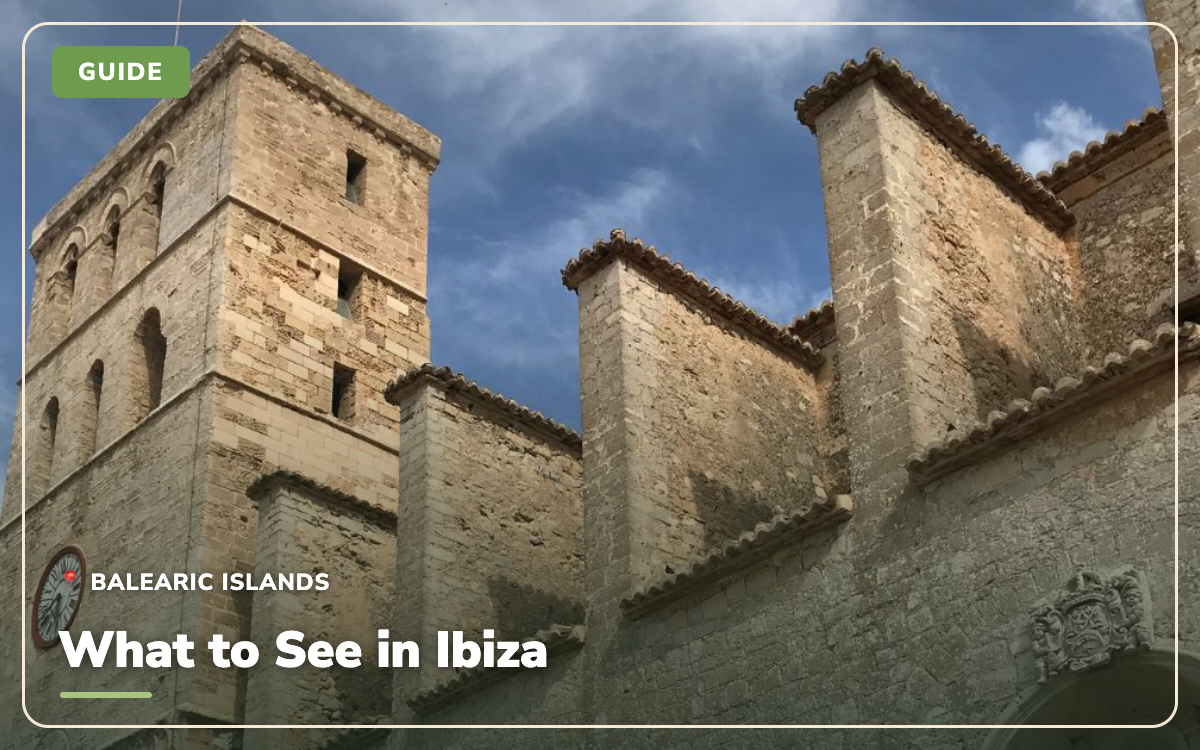
Ibiza has a reputation as the island where the clubs keep going until sunrise — which is a shame, because beyond the fences and the dance floors hides one of the most photogenic corners of the Mediterranean. A whitewashed, walled old town rising above the harbour, a mysterious rock jutting straight out of the sea, beaches with water like something off a postcard, and hippie markets that have kept the faith since the 1970s. This guide is all about what to see in Ibiza when what you’re really after is the places, the scenery and the atmosphere.

You’ll save the most by travelling in May/June or September, having at least breakfast at your accommodation from a local supermarket, and favouring beaches with beach clubs over paid sunloungers. Compare places to stay across the options on Ibiza →, and browse experiences and day trips (such as a boat around Es Vedrà) through GetYourGuide →.
What to see in Ibiza in a nutshell
- Top experience: Dalt Vila — the walled old town above the harbour, a UNESCO World Heritage Site.
- The island’s icon: the Es Vedrà rock, seen from the Torre des Savinar viewpoint or from Cala d’Hort beach.
- Best beaches: Cala Comte, Cala d’Hort and Ses Salines, with their turquoise water.
- Sunsets: the promenade in Sant Antoni (Café del Mar) and the west coast.
- An extra day out: a full-day boat trip to quieter Formentera.
- A car comes in handy — rental from roughly €20–40 a day. The currency is the euro.
When to Visit Ibiza
Ibiza is at its busiest and priciest in July and August — that’s when the club season is in full swing, the beaches are heaving and accommodation prices climb. If you’re coming mainly for the sights and the photos, the loveliest windows are May–June and September to early October: the sea is warm, the days are long, and you can actually breathe on the beaches and in the lanes of Dalt Vila. April and October are quiet and cheap, though some venues and beach spots may not yet (or no longer) be running at full tilt. We go into the detail in our article Weather in Ibiza.The island is small — you can drive from one end to the other in about an hour — so it’s easy to loop around in just a few days. How much time to set aside and how to piece a trip together, we cover in A Weekend in Ibiza and A Holiday in Ibiza.
Getting Around Ibiza
Buses connect the main towns (Ibiza Town, Sant Antoni, Santa Eulària) and plenty of beaches too, and they’re cheap — a single fare is roughly €2–4. For the more remote coves, for Es Vedrà and for the interior, though, you’ll struggle without a car or scooter, as services out there are sparse. Hiring a car works out at roughly €20–40 a day, more in peak season, and the cars disappear fast — book ahead. Bear in mind that at the most popular beaches (Cala Comte, Ses Salines) the car parks fill up by mid-morning, and some of them charge.💡 Tip: Head to the prettiest beaches and to Es Vedrà first thing in the morning, or else late in the day for the sunset. Between eleven and four it’s at its most crowded and parking is at its worst.
You can compare flights and dates through Kayak →. Where to lay your head, we cover in A Holiday in Ibiza, and you can compare places to stay straight away across the options on the island →.16 Things to See in Ibiza
So, what to see in Ibiza? Here’s our pick of favourite spots right across the island: from landmarks and viewpoints to the prettiest beaches and quietest towns. Choose whatever appeals to you most.1. Dalt Vila — the Walled Old Town (UNESCO)
The heart of the island and its biggest must-see. Dalt Vila (“upper town”) is the fortified historic core of Ibiza Town, protected by mighty 16th-century walls built to keep pirates out — and the whole thing is on the UNESCO list. You enter through the Portal de ses Taules gate and climb a maze of narrow cobbled lanes lined with white houses, right up to the cathedral and the former castle at the top, where the view takes in the harbour, the sea and Formentera in the distance. The walk itself is free; you only pay for a few museums (the archaeological museum, MACE — the museum of contemporary art; admission tends to be nominal, a few euros).💡 Tip: Head up in the late afternoon — during the day the cobbles bake and shade is scarce. Come evening the lanes light up, cool down, and from the walls you’ll catch a lovely sunset over the harbour.
2. The Harbour and the Sa Penya Quarter
Right below the walls lie the old harbour and the fishing quarter of Sa Penya, along with neighbouring La Marina — a tangle of narrow lanes with white houses, little shops and cafés. In the evening a hippie market and street traders come to life, and it’s a lovely spot for a stroll and dinner with floodlit Dalt Vila rising overhead. It’s free, and it’s the best possible introduction to the island’s atmosphere on your very first evening.3. Es Vedrà — the Mysterious Rock in the Sea
The iconic image of Ibiza: Es Vedrà is a limestone rock nearly 400 metres high, rising steeply out of the sea off the south-west coast. It comes wrapped in legends — about UFOs, magnetic fields, and the claim that it’s one of the most “magnetic” places on earth. Believe it or not, the rock’s silhouette at sunset is unforgettable. The best view is from the viewpoint by the old watchtower Torre des Savinar (Torre del Pirata), a short walk from the car park, or from below at Cala d’Hort beach. The spot is free.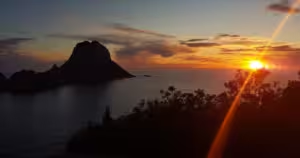
4. Cala d’Hort — the Beach with a View of Es Vedrà
A little cove directly facing Es Vedrà — and it’s exactly that view that makes it one of the island’s prettiest beaches. It’s a pebble-and-sand beach with a handful of fishermen’s huts and a few restaurants, where you can tuck into fresh fish with the best backdrop on the island. Come early: parking is limited and fills up fast in season.💡 Tip: Bring something to drink for sunset and settle in on the rocks — the sun sets right behind Es Vedrà, and it’s one of the finest sunsets on the island, completely free.
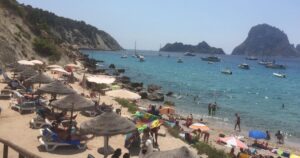
5. Cala Comte (Cala Conta) — the Most Beautiful Water Colours
For many, the most beautiful beach in Ibiza. Cala Comte is a string of coves with white sand, low rocks and water in unbelievable shades of turquoise and blue, with a few islets on the horizon. It faces west, so it’s also a superb spot for sunset — in the evening half the island rolls up here. Beach access is free; a sunlounger and parasol set at the beach club run to roughly €20–30 a set.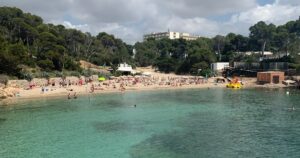
6. Cala Salada and Cala Saladeta
A quieter pair of coves north of Sant Antoni, ringed by pines. Cala Salada is the more accessible of the two; you reach neighbouring Cala Saladeta along a rocky footpath — and it’s the smaller one that has that famously crystal-clear water. There’s less room here, and in summer the car park closes as soon as it’s full, so aim to arrive early or come by bus or bike.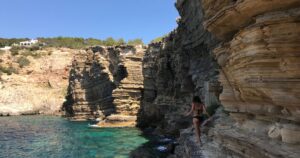
7. Ses Salines — Salt Flats, Flamingos and a Beach
On the south of the island lies the Ses Salines nature park, with its ancient salt lakes where salt is still harvested to this day and where, during the migrations, you might spot flamingos and other birdlife. The park also takes in one of the island’s best-known beaches — Platja de ses Salines (Las Salinas), a long ribbon of white sand with turquoise water and beach bars. Entry to the park and the beach is free; the car park usually charges.💡 Tip: The salt flats are at their loveliest in the evening light, when the surface turns pink. Your best chance of flamingos is in spring and autumn, not in the height of summer.
8. Sunset in Sant Antoni (Café del Mar)
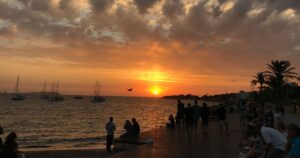
Sant Antoni (Sant Antoni de Portmany) is the clubbing side of the island, but even for non-party travellers it holds one big draw — sunset along the western promenade. This is where the legendary Café del Mar was born, along with the string of venues beside it, where people gather to watch the sun drop into the sea. You’ll pay for a drink at the bar, but the show itself from the promenade and the rocks is free — just turn up about an hour ahead and find yourself a spot.💡 Tip: In peak season it’s shoulder to shoulder here at sunset. If you want a bit of calm, choose Cala Comte or Cala d’Hort instead — the sunset is every bit as good, with fewer people.
9. Formentera — a Trip to the Neighbouring Island
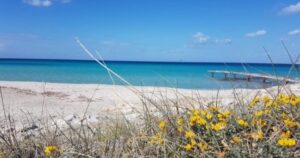
Just south of Ibiza lies smaller, far quieter Formentera, with beaches that get called “Caribbean” — above all Playa de ses Illetes, with its white sand and shallow turquoise water. The ferry from Ibiza Town harbour runs several times a day, the crossing takes roughly 30–40 minutes, and a return ticket costs about €40–55. On the island itself, getting about by bike or scooter is a joy. It’s easy to spend a whole day there.💡 Tip: Catch the earliest morning ferry to Formentera and come back late — the island deserves a full day, and afternoons are when the ferries and beaches are at their busiest.
10. Las Dalias — the Hippie Market in Sant Carles
The island’s most famous market, keeping the spirit of hippie Ibiza alive since the 1970s. Las Dalias in Sant Carles (Sant Carles de Peralta) runs every Saturday from roughly February to November, and from June to September it also runs as a night market (Sunday, Monday and Tuesday evenings from 7 p.m.). Across more than 300 stalls you’ll find clothes by local designers, silver jewellery, handmade crafts, art and music — and above all, the atmosphere. Entry is free. The Punta Arabí market in Es Canar (Wednesdays) has a similar feel.11. Lighthouses — Punta des Moscarter and Far des Botafoc
If you’re a fan of lighthouses and long views, Ibiza won’t disappoint. Far de Punta des Moscarter near Portinatx in the north is the tallest lighthouse in the Balearics (52 m) and stands on the cliffs with a sweeping outlook over the sea. Far des Botafoc guards the entrance to Ibiza Town harbour and gives a beautiful view back towards Dalt Vila. If you make it over to Formentera, add Far de la Mola on its eastern tip. All of them are freely accessible from the outside.12. The Interior — Santa Gertrudis and the Can Marçà Caves
Ibiza isn’t all coastline. Inland you’ll find peaceful white villages such as Santa Gertrudis (cafés, galleries, tapas) or Sant Miquel, with its white hilltop church. Nearby is the Cova de Can Marçà cave above the bay of Port de Sant Miquel, which you visit on a guided tour (admission around €15). It makes a good plan for a hot day, or for when you fancy a break from the beaches.13. Cala Benirràs — Sunset with Drums
A small cove in the north, ringed by pines, with crystal-clear water and the unmistakable rocky silhouette of Cap Bernat — nicknamed “the finger of God” — rising out of the sea directly opposite the beach. Cala Benirràs is most famous for its Sunday drumming sessions: come evening, people have gathered here since the hippie days to greet the sunset with music. Entry is free, though the car park above the beach fills up quickly.💡 Tip: To catch the famous “drum sunset”, turn up on a Sunday in the late afternoon and expect crowds and tricky parking. If it’s peace you’re after, arrive in the morning, when the cove is all but empty.
14. Sa Talaiassa — the Island’s Highest Point
Above the village of Sant Josep rises Sa Talaiassa (Sa Talaia), at roughly 475 metres the highest point in all of Ibiza. On a clear day you can see across much of the island, all the way to Es Vedrà and neighbouring Formentera. A waymarked path leads up from the village through pine forest; the climb takes about an hour and is free. It’s one for anyone who wants to take in the island from on high and pair the view with a walk.15. Puig des Molins — the Phoenician Necropolis
A short way from Dalt Vila lies Puig des Molins, one of the best-preserved Phoenician-Punic burial grounds in the Mediterranean, with thousands of tomb chambers cut into the hillside. Together with the old town it is inscribed on the UNESCO list. Right by the site stands a dedicated museum displaying finds from the island (admission around €2–3). It’s a quiet stop for history lovers that’s easy to add to a walk around Dalt Vila.16. Santa Eulària des Riu — the Island’s Quietest Town
The island’s third-largest town and its most laid-back face. Santa Eulària des Riu tempts you with a long palm-lined promenade, a harbour full of yachts and pleasant restaurants without the club din. Above the town rises the church hill of Puig de Missa, with its white fortified church and views over the surroundings. The town’s name even nods to the only river in the Balearic Islands. It’s a good choice for a calmer evening and for families.How Much It Costs (Budget)
Ibiza can be expensive, especially in July and August — but a lot of the very best of it (Dalt Vila, Es Vedrà, the beaches, the sunsets, the markets) is free or nearly free. A rough daily budget for a couple outside peak season:| Item | Roughly per day (2 people) |
|---|---|
| Accommodation (apartment / guesthouse) | €70–140 |
| Food (bistros + your own breakfast) | €40–70 |
| Car (rental + fuel + parking) | €30–55 |
| Entry fees, trips, sunloungers | €10–50 |
| Total | roughly €150–315 per day |
Where to stay in Ibiza
The island has three faces. Ibiza Town with the Dalt Vila old town and the port, San Antonio with cheaper beds and the sunset strip, and the north of the island with Santa Eulalia and quiet coves. If you are here for sights and beaches rather than clubs, go north or to Ibiza Town.
- Budget: a hostel bed in San Antonio roughly €30 to €60 per person per night.
- Mid-range: a double room in Ibiza Town €120 to €220 in season.
- For quiet: Santa Eulalia and the northern coves.
- Worth knowing: August is the peak. The same room can cost a third of that in May or October.
Compare current prices and availability through accommodation in Ibiza.
Where to Next
- A Holiday in Ibiza
- A Weekend in Ibiza
- Weather in Ibiza
- Ibiza: Parties and Clubs
FAQ: What to See in Ibiza
Experiences and tickets in Ibiza
traveller-approved · GetYourGuide
★ Our pick

Ibiza: Full-Day Trip to Formentera (All-Inclusive)
★ 4.7 · 1,125 reviews
from €109
Book this experience →

Prices and ratings are indicative (source: GetYourGuide); you’ll see the latest once you click through.
What is there to see in Ibiza if you’re not going for the parties?
Plenty — the walled old town of Dalt Vila (UNESCO), the Es Vedrà rock, the prettiest beaches (Cala Comte, Cala d’Hort, Ses Salines), sunsets along the west coast, the Las Dalias hippie market and a day trip to peaceful Formentera. Ibiza has a strong “daytime” and natural side, not just the clubs.What can you see in Ibiza in one day?
In the morning, walk around Dalt Vila and the harbour in Ibiza Town; in the afternoon head south-west to Es Vedrà and to Cala d’Hort or Cala Comte beach, and stay there for the sunset. That way you’ll cover the history, the iconic rock and the most beautiful water.Which is the most beautiful beach in Ibiza?
Cala Comte (Cala Conta) is often called the loveliest, thanks to its shades of turquoise water and its sunsets. Cala d’Hort, with its view of Es Vedrà, is just as photogenic, as are the long Ses Salines and quieter Cala Saladeta near Sant Antoni.Is a car worth it in Ibiza?
For the more remote beaches, for Es Vedrà and for the interior, yes — buses out there are infrequent. Rental works out at roughly €20–40 a day, more in season, and cars disappear fast, so book ahead. Around the main towns and some beaches you can get by on the cheap bus.How do you get to Es Vedrà?
You can’t usually set foot on the rock itself — it’s a protected area. The best views are from the viewpoint by the Torre des Savinar tower or from below at Cala d’Hort beach, both reachable by car. You can also sail out around the rock on a boat trip.Is a trip to Formentera worth it?
Yes, if you have a day to spare. Formentera is quieter than Ibiza and has some of the most beautiful beaches in the whole Mediterranean (Ses Illetes). The ferry takes 30–40 minutes and a return ticket costs roughly €40–55.When is the best time to visit Ibiza?
For a more relaxed look around the island, May–June and September to early October: warm sea, long days and bearable crowds and prices. July and August are the busiest and most expensive, while April and October are the quietest, though some venues may not be running at full tilt.How many days should you set aside for Ibiza?
For the essential “what to see”, 3–4 days is enough. Ideally, 5–7 days lets you take in the old town, the west coast with Es Vedrà, a few beaches, a market and a Formentera trip without rushing.
Potřebujete pomoct s cestováním?
-
Ubytování 🏨
Vyberte si to nejlepší ubytování, ať už jste kdekoliv, přes Booking.com. -
Půjčení auta 🚗
Auto si snadno najdete přes Booking.com, kde máte často slevu díky ubytování, nebo Rentalcars.com, kde porovnáte nabídky většiny půjčoven. -
Zážitky 🎟️
Přes GetYourGuide.com si vyberete z nejrůznějších výletů i zážitků po celém světě, navíc se zrušením zdarma do 24 h předem.