Last updated 29.8.2026
Sand dunes that creep a few metres inland every year and bury a pine forest as they go. A beach so wide and so long that you can walk for an hour and still not reach the end of it. And a town that once had to pick itself up and move because the sand was winning. Łeba sits on Poland’s Baltic coast, roughly halfway between Gdańsk and Słupsk, and people come here for one thing you will not see anywhere else in Europe. Below are 15 things to do in Łeba, Poland, plus how to get here without a car, what it costs in złoty, a wet-weather plan and a warning about the two attractions almost everyone mixes up.
In short: Łeba, Poland and its shifting dunes
- The reason to come is the shifting sand dunes in Słowiński National Park. They rise to around thirty metres and travel three to ten metres inland every year.
- You cannot drive to the dunes. Cars stop at Rąbka, and from there it is a walk, an electric buggy or a boat across the lake.
- Łeba Park and Sea Park Sarbsk are not the same place. The first is a dinosaur park, the second an aquarium with seals. Visitors confuse the two and end up disappointed.
- The harbour splits the beach in two: a busier western half and a quieter eastern half. You notice the difference within minutes.
- Gdańsk is the nearest big airport, about 110 km and an hour and a half away by car. Lębork, roughly 30 km inland, is the nearest railway hub.
- The Baltic is cold, even in August. Anyone planning to spend whole days in the water is in for a surprise.
- June and September are the sweet spot, with far fewer people in Łeba and accommodation at a fraction of peak-season rates.
Łeba, Poland: where it is, how to say it, and why the town moved
Łeba lies in the Pomeranian Voivodeship in northern Poland, where the river of the same name meets the Baltic Sea, right next to the enormous Lake Łebsko. Gdańsk and the Tricity are about an hour and a half to the east, Słupsk is the nearest sizeable town to the west. It is a small place: only around 3,600 people live here year round, and in summer that number multiplies several times over.
First, the name. The Polish Ł is not an English L. It is pronounced like the English W, so Łeba comes out roughly as “WEH-bah”, not “LEE-ba”. Say it that way at the ticket window and you will be understood immediately. You will also see the town written as Leba in booking systems and on some road signs abroad, which is the same place.
The most interesting thing about Łeba is its history. The original town stood somewhere else, and for centuries it was battered by flooding and by the advancing sand until people finally gave up and rebuilt the town on safer ground after 1558. Sand here is not a tourist attraction. It is a force that once rewrote the map, and all that remains of old Łeba are the ruins of a church out in the dunes.
During the Second World War the area was used as a rocket range. Between 1941 and 1945 the Rheinbote was tested here, and from 1943 the V-1 flying bomb. What is left of the range at Rąbka is now an open-air museum.
Słowiński National Park: why these dunes are unusual
Plenty of European coastlines have dunes. What makes this stretch different is that the sand here is genuinely on the move. Wind off the Baltic pushes it inland at a measurable pace, and instead of being pinned down by marram grass it swallows whatever stands in its way, including mature pine forest. Walk far enough and you pass dead trunks sticking straight up out of the sand, the tops of trees that were buried decades ago.
Słowiński National Park was established in 1967, covers more than 186 square kilometres today and has been a UNESCO biosphere reserve since 1977. It protects the whole system: the dune belt, the shallow coastal lakes behind it, the peat bogs and the bird life that depends on them. That is also why the rules feel strict. You stay on marked routes, you do not drive in, and large parts of the park are simply closed to visitors.
The practical upshot for a first-time visitor is that the dunes are a half-day outing rather than a photo stop. Budget the time, take water, and read the section below on how to actually get out there.
15 things to do in Łeba, Poland
The list runs from the one thing nobody should skip to the rainy-day fillers, so you can build a two-day or a four-day plan out of it.
1. The shifting sand dunes in Słowiński National Park
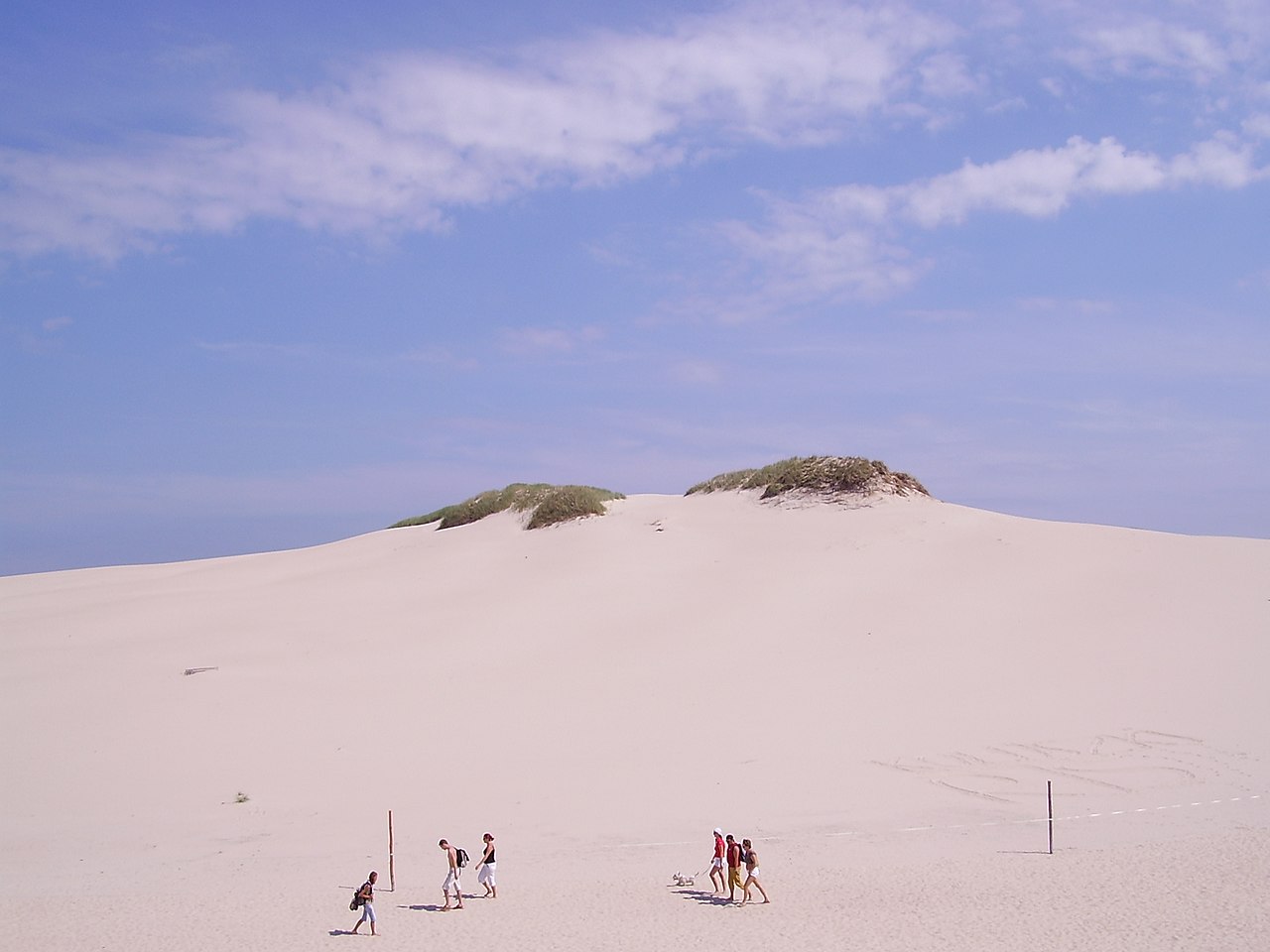
This is why people come. West of Łeba a belt of pale sand runs inland, driven by the wind, burying the forest as it advances. The tallest dunes reach around thirty metres and move three to ten metres a year. Standing on top, you have the sea on one side and, on the other, an endless white plain studded with the bleached trunks of dead trees. It looks like the Sahara has been dropped onto the Baltic, and it is a short drive from one of Poland’s biggest cities.
Go with the light in mind. Early morning gives you long shadows across the ridges and a chance of having the crest to yourself. Late afternoon gives you the sea backlit behind the sand. Midday gives you glare, heat and crowds.
2. How to actually reach the dunes
This is where most day trips go wrong. You cannot drive to the dunes. The road ends at the park entrance in Rąbka and vehicles go no further. You have three options:
- On foot. Roughly an hour from the entrance to the dunes along a surfaced track. Free, but hard work with small children or in the midday heat.
- By electric buggy. Small electric road trains run from the entrance and take you almost all the way. Paid separately, and in season you queue for them.
- By boat across Lake Łebsko from the harbour in Łeba. The prettiest option, and also the longest and the priciest.
Park admission is charged separately from transport, so a family pays twice. And remember that you come back the same way, so halve whatever time and energy you think you have.
The most common mistake: setting off for the dunes at noon. There is not a scrap of shade on the sand, the sun bounces straight back up at you and there is nowhere to buy water. Go early in the morning or after four in the afternoon, when the light is better for photographs and the sand is cool enough to cross barefoot.
3. Łeba’s beaches: west and east
The harbour and the river mouth split the sand into two halves that behave completely differently. The western beach is closer to the centre, backed by the promenade, the food stalls and the sunlounger hire, and it takes the crowds. The eastern beach, beyond the harbour, is wider and calmer, and the further you walk from town the fewer people you meet. Both have fine pale sand and shelve gently into the water, which makes Łeba a sound choice for families with young children.
Do not underestimate the temperature. The Baltic is cold. Even in August the water routinely sits below twenty degrees, and an onshore wind drops it further. Swimming here is a quick dash between long spells of lying on the sand, not an afternoon activity.
4. The harbour and the evening promenade
The fishing harbour at the river mouth is the nicest corner of Łeba after sunset. Fishing boats and excursion catamarans tie up along the quay, fish stalls line the pier and a promenade runs from the moorings down to the beach. This is where the evening actually happens in Łeba, because there is not much of a nightlife scene otherwise.
5. The rocket museum in Rąbka
On the site of the old German rocket range, in pine woods just outside town, there is now an open-air museum with rocket replicas and the remains of launch equipment. It is not large, and an hour covers it, but it sits directly on the road to the national park entrance, so it slots neatly into a dune day.
6. Lake Łebsko
Immediately behind the dunes lies Łebsko, 71.4 square kilometres in area, which makes it one of the largest lakes in Poland. It is shallow, separated from the sea by nothing more than a strip of sand, and it is an important bird breeding ground. A nature trail with observation platforms runs along the shore, and excursion boats cross it towards the dunes.
7. Lake Sarbsko
A smaller lake east of town and the local watersports base. It is shallow and flat, so this is where people learn to windsurf and kitesurf, and it is considerably warmer than the sea. For families who want to get in the water and find the Baltic too cold, this is the answer.
8. Łeba Park: the dinosaur park
A theme park with life-size dinosaur models, prehistory exhibits and rides for children. It is big, half a day disappears easily, and in high season it is packed.
9. Sea Park Sarbsk: seals and the marine world
This is the attraction people confuse with the dinosaur park. Sea Park is all about the sea: aquariums, marine life exhibits and, above all, the seals that most visitors actually come for. It sits a few kilometres from Łeba towards Sarbsk. If you are setting aside one day for “the park”, make very sure which of the two you are heading to, because the two experiences have nothing in common.
10. The Amber Museum
A small exhibition in the centre of town devoted to Baltic amber: how it forms, how it is worked and what has been found along this coast. An hour covers it, and it is the classic rainy-day option. Amber can also be picked up on the beach itself after a storm, mainly on the eastern stretch.
11. Stilo lighthouse
A steel lighthouse from the early twentieth century standing among forest and dunes west of Łeba. You can climb it, and from the gallery the whole coastal strip opens up. Treat it as a half-day trip: it is around 56 kilometres by car, because you have to drive right around the national park, though the route runs through pleasant countryside. By bike you can cut through the park on a shorter path.
12. Alexa Farm in Charbrowo
An animal farm with paddocks where children can feed the animals, plus a playground and small rides. The standard option for families with pre-schoolers, and a good way to fill a grey morning when nobody fancies the beach.
13. Czołpino lighthouse
The least besieged of the three lighthouses in the area. It stands inside Słowiński National Park on a wooded dune, and about a hundred and fifty steps lead to the top. From the gallery you see the whole coastal strip and Lake Łebsko, a view you simply do not get from the foot of a dune. You approach from Smołdzino and walk in through the forest from the car park, which puts off most of the crowd. It usually opens in season only.
14. Kayaking on the Chełst
The Chełst is a short, placid little river linking Lake Sarbsko with the sea, and it is impossible to get wrong because it has neither current nor rapids. Rental places in Łeba hire kayaks by the hour or by the half day. For families with children it is the best way to spend a morning on the water with no risk attached. Longer routes head inland along the River Łeba.
15. Mazes and rope parks
There are several in and just outside Łeba: Labirynt Park with a mirror maze and a hedge maze, Park Linowy Alfa with rope obstacles strung between the trees, and a handful of smaller trampoline grounds. These are standard holiday attractions and the prices reflect it. They earn their keep when it rains, or when the sea is too cold to swim in, which on the Baltic is hardly unusual even in July.
What is overrated in Łeba
So that this does not read as one long list of superlatives, here are a few things that did not win us over:
- The main promenade street in season is one continuous row of stalls selling inflatable toys and waffles. Anyone expecting a genteel old spa town will be disappointed. Łeba is a holiday town first and does not pretend otherwise.
- Inflatable fun parks and similar attractions are expensive and you have exactly the same thing at home.
- Hour-long sightseeing cruises out to sea are pleasant enough, but the better boat trip is the one across the lake to the dunes.
How to get to Łeba, Poland
Łeba is not on the way to anywhere, and the journey needs planning. There is no airport and no motorway anywhere near it, so almost everyone arrives via Gdańsk or via the railway at Lębork.
| Arriving from | Distance to Łeba | How it works |
|---|---|---|
| Gdańsk (nearest large airport) | 110 km | about 1.5 hours by car |
| Lębork (nearest railway hub) | about 30 km | onward bus, or a direct train in season |
| Elsewhere in Poland | varies | motorway and expressway, then local roads for the final stretch |
By air. Gdańsk (GDN) is the practical gateway and is served from a good spread of European cities, including several UK airports, mostly by low-cost carriers and mostly seasonally. Check the current timetable rather than assuming a route exists in May because it existed in July. From the airport, hiring a car is the simplest onward move.
By car. The drive from Gdańsk follows expressways for most of the way and then drops onto ordinary roads for the last stretch to the coast. Some Polish motorway sections carry tolls, paid electronically these days through the e-TOLL PL app, or in cash and by card at the traditional toll gates on the concession-operated sections. A hire car picked up at Gdańsk airport is worth the money if you plan to see anything beyond the beach.
By train and bus. Without a car, take a train to Lębork, the nearest larger station roughly 30 kilometres from Łeba, then continue by bus or, in the summer season, by direct train. Trains to Lębork connect through Gdańsk. Coming from further afield with changes, put aside a full day for the journey.
A car is genuinely useful in Łeba. You can walk everywhere within the town, but every attraction worth the detour, Sea Park, Stilo lighthouse, the farm, is scattered around the surrounding countryside and the bus links between them are thin. Parking in the centre is charged in season, and finding a space near the beach after nine in the morning is a matter of luck.
Getting around Łeba
Łeba is small enough to cover almost entirely on foot. Even so, a few things are worth knowing:
- Meleksy, the little electric buggies that seat a handful of passengers, run in season between the centre, the harbour and the park entrance at Rąbka. You pay per ride, and it is the easiest way to reach the dunes without a car.
- Sightseeing road trains loop around the centre, the beach and the harbour, working as transport and as a ride for children at the same time.
- Bikes are the quickest way around Łeba. A cycle path runs from town out to Rąbka and on to the edge of the dunes, where you leave the bike at a rack.
- Do not drive into the centre in season. The streets are narrow, parking is charged and the main road down to the beach clogs up in the afternoon.
When to visit Łeba and for how long
The season on the Polish Baltic is short and intense.
- July and August: warmest, but full and at their most expensive. Accommodation needs booking months ahead.
- June and September: in our view the best compromise. The sea is at its warmest in September after a summer of heating up, there are noticeably fewer people and prices come down.
- May and October: no good for swimming, but ideal for the dunes, cycling and walking the beach, and you get the place more or less to yourself.
- Winter: Łeba out of season is close to dead and most businesses shut. The dunes, however, are beautiful all year round.
Give Łeba three to four days if you want the dunes, both beaches and one attraction in the surrounding area. It also works as a base for a full week, just be aware that the programme starts repeating and you will probably spend one day on a trip further along the coast.
Where to stay in Łeba
Łeba is built on tourism, so there is plenty of accommodation and the difference is mostly location:
- By the western beach and the promenade: everything on foot, the most bars and restaurants, and also the noisiest and priciest.
- Beyond the harbour by the eastern beach: quieter, newer apartments, ten to fifteen minutes’ walk into the centre.
- In Rąbka: at the national park entrance and in the pine woods. The best choice if you are here mainly for the dunes and the cycling.
- Campsites: there are lots of them nearby and they are well equipped. They fill up in season, so book ahead.
You can compare places to stay in Łeba and the surrounding villages on a single map through Stay22. One booking note specific to this coast: a lot of the accommodation is family-run guesthouses and holiday cottages rather than hotels, English is not guaranteed at reception, and many places quote per-person rather than per-room rates.
Prices and budget in Łeba
Poland stopped being dirt cheap a long time ago, but set against the Mediterranean resorts of Croatia, Italy or Spain the difference is still obvious, and the exchange rate is kind to anyone paying in pounds. Roughly 5 złoty to the pound is close enough for mental arithmetic. What to budget for:
- National park admission is charged per person and is a small amount, on the order of a few tens of złoty for a family, so somewhere around £5 to £10.
- Transport to the dunes by electric buggy or boat is paid separately and usually costs more than the admission itself.
- The big attractions, Łeba Park and Sea Park, are the largest single item of the day. Expect roughly fifty to a hundred złoty per person, in the region of £10 to £20.
- Food in the fish bars by the harbour is decent and sensibly priced. The promenade restaurants cost more for the same thing.
- Parking in the centre is charged by the hour in season.
Card payments work almost everywhere, including at the stalls. Poland uses the złoty and not the euro, so bring a card that does not charge for foreign transactions, and keep some cash for small purchases and parking machines.
What to do in Łeba when it rains
The Baltic can go grey for three days at a stretch, and with small children that is a problem. A wet-weather plan:
- Sea Park Sarbsk, because a large part of the exhibits are indoors.
- The Amber Museum in the centre.
- The aquapark, or the pool at one of the larger hotels, several of which open them to non-residents.
- A half-day trip to Gdańsk or to Lębork, on the grounds that rain is easier to spend in a town.
- A walk along the beach after a storm, which is the best time of all to hunt for amber.
Mistakes to avoid in Łeba
- Expecting to drive right up to the dunes. You cannot, and do not try to get around it on forest tracks, because they are inside the national park.
- Underestimating the distance. Łeba is a long way from the nearest motorway and from Gdańsk airport, and the last stretch is slow. It is not a place you drop into for one night.
- Turning up in July without a booking. Łeba sells out in high season.
- Planning the holiday around swimming. The Baltic is cold and the onshore wind sharpens it. Treat it as a holiday by the water, not in it.
- Mixing up Łeba Park and Sea Park Sarbsk. We have now mentioned it twice, and it is the single most common disappointment among visitors here.
Where next along the Polish Baltic coast
With more days on the Baltic, Łeba combines well with other stops:
- Gdańsk, Sopot and Gdynia, together known as the Tricity, are an hour and a half to the east and make for a completely different kind of trip: a proper city, the architecture of the old town and the pier at Sopot.
- Hel, out on its long thin peninsula, reachable by boat from Sopot.
- Ustka and Rowy to the west, smaller and quieter resorts.
- Słupsk as the nearest larger town and another rainy-day option.
If you would rather trade the coast for mountains later in the trip, the Karkonosze Mountains in Poland sit at the opposite end of the country and pair well with a Baltic week.
Łeba FAQ
Why do people go to Łeba?Mainly for the shifting sand dunes in Słowiński National Park, which rise to around thirty metres and travel three to ten metres inland every year. On top of that Łeba has a wide sandy beach that shelves gently into the water and several large attractions aimed at families with children.
How do you get to the shifting sand dunes in Poland?You cannot drive to them, as the road ends at the park entrance in Rąbka. From there it is roughly an hour on foot, or you take an electric buggy, or you cross Lake Łebsko by boat from the harbour in Łeba. Park admission is charged separately from the transport.
How do you get to Łeba and Słowiński National Park from Gdańsk?Gdańsk is about 110 kilometres away, roughly an hour and a half by car, which makes it the obvious airport and the obvious base for a day trip. Without a car, take a train to Lębork, the nearest larger station about 30 kilometres from Łeba, and continue by bus or by direct train in the summer season.
What is the difference between Łeba Park and Sea Park Sarbsk?Łeba Park is a dinosaur park with life-size models. Sea Park Sarbsk is a marine centre with aquariums, marine life exhibits and seals. They are two separate places a few kilometres apart, and mixing them up is the most common mistake visitors make here.
Can you swim in the Baltic Sea at Łeba?Yes, and the beach is a good one for it, with fine sand and a gentle shelf into the water. Be ready for the temperature, though. Even in August the sea routinely stays below twenty degrees and an onshore wind cools it further, so swimming tends to be a short dash rather than an afternoon in the water.
Is Łeba a good place for a holiday with young children?Yes. The beach has fine sand and shallow water, the town and its surroundings have several large attractions, and you can walk everywhere. Bear in mind that the Baltic is cold even in summer, and that you will not get a pushchair out to the dunes.
When is the best time to visit Łeba?June and September. The sea is at its warmest in September after the summer, there are noticeably fewer people than in peak season and accommodation prices drop. July and August are the warmest months but also the busiest and the most expensive.
Can you find amber on the beach in Łeba?Yes, and the best time is after a storm, when the sea washes clumps of seaweed onto the shore with pieces of amber tangled in them. The eastern beach beyond the harbour is the most productive stretch. There is also an amber museum in the town itself.
Potřebujete pomoct s cestováním?
-
Ubytování 🏨
Vyberte si to nejlepší ubytování, ať už jste kdekoliv, přes Booking.com. -
Půjčení auta 🚗
Auto si snadno najdete přes Booking.com, kde máte často slevu díky ubytování, nebo Rentalcars.com, kde porovnáte nabídky většiny půjčoven. -
Zážitky 🎟️
Přes GetYourGuide.com si vyberete z nejrůznějších výletů i zážitků po celém světě, navíc se zrušením zdarma do 24 h předem.