Last updated 23.8.2026
Valencia is the easiest of Spain’s big cities to like. It has no Barcelona queues, none of Madrid’s hurry, and it still gives you the sea, an old town you can lose a whole morning in, and one of the boldest pieces of modern architecture in Europe. It is also one of the sunniest places in Spain, right through the year. We have put together 41 things to see in Valencia, from the white shells of the City of Arts and Sciences to a Gothic silk exchange and the rice fields south of town, plus transport, itineraries for one to four days and advice on when to go.
In short: what to see in Valencia in a few days
- All 41 places in this article are grouped by district, so you can walk them in clusters instead of crossing the city for each one.
- The single biggest draw is the Ciudad de las Artes y las Ciencias, the futuristic complex with the L’Hemisfèric planetarium, a science museum and the Oceanogràfic aquarium.
- Oceanogràfic is the largest oceanographic aquarium in Europe, and it was designed by Félix Candela, not Calatrava, as is often written.
- The historic centre fits into one morning. The Lonja de la Seda silk exchange is the only UNESCO World Heritage site inside the city itself.
- Turia Park is nine kilometres of former river bed turned into greenery. A bike is the best way through it, and it takes you almost everywhere.
- With kids, the safe bets are Bioparc, Oceanogràfic, Parque Gulliver and the city beach, which you reach by tram.
- Manises airport sits eight kilometres west of the city and the metro from it into the centre takes about a quarter of an hour.
- Give Valencia three days, ideally four. Two days covers only the essentials, a weekend works but at a jog.
Ciudad de las Artes y las Ciencias: what to see in Valencia first
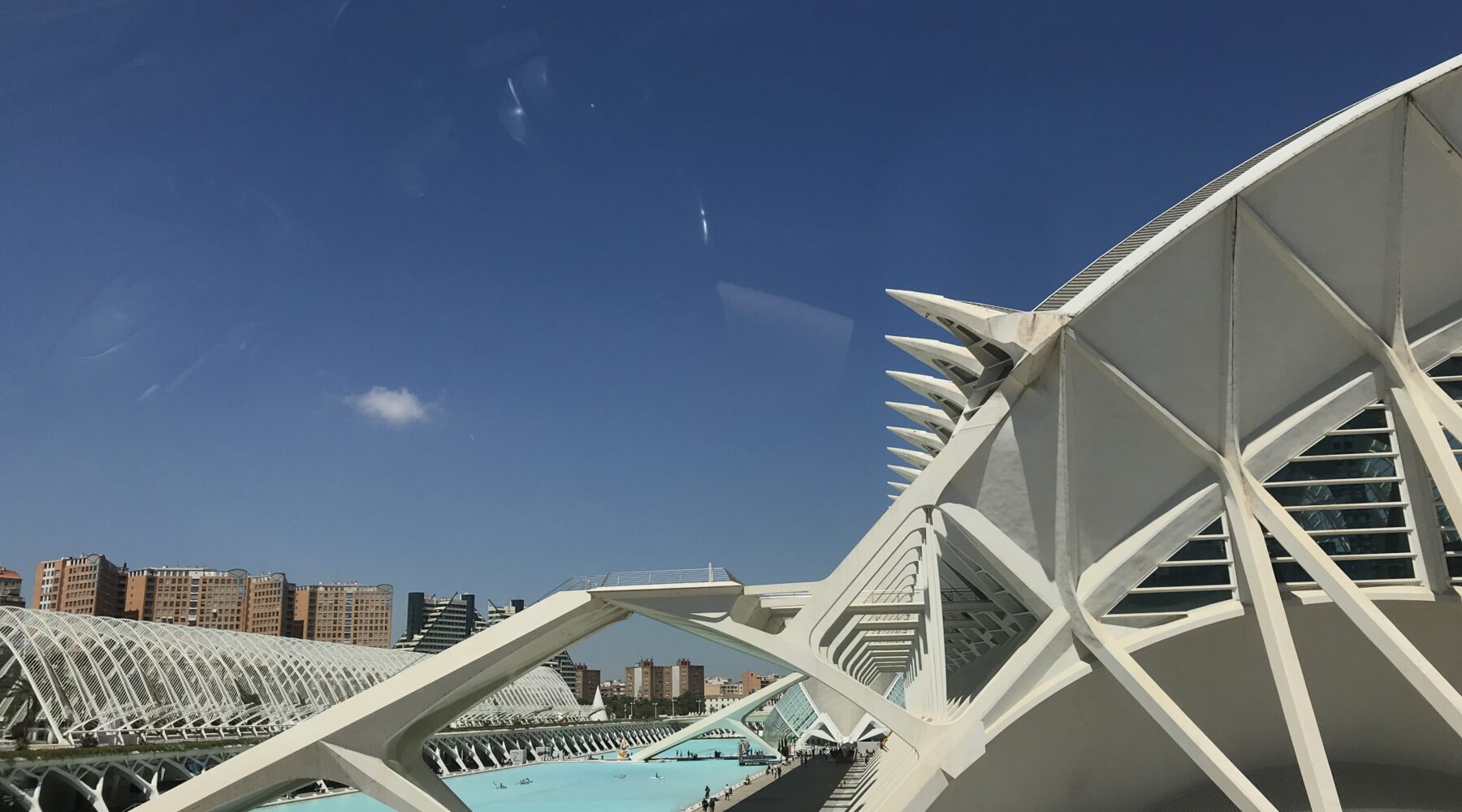
Ask anyone what to see in Valencia and this is what most of them picture. The City of Arts and Sciences sits in the southern stretch of the old river bed and looks as if it had been cut out of a different century: white concrete shells, mosaic made of broken tiles, shallow pools that reflect everything twice over. Most of the complex was designed by Santiago Calatrava, who was born in Valencia, and it went up in stages from the late 1990s onwards.
On the ground it is a little less majestic than the photographs suggest. At midday there is nowhere to hide from the sun, the white concrete throws light back at you hard enough to make sunglasses non negotiable, and the main pool is usually lined with people taking selfies. Come early in the morning or an hour before sunset. The buildings lit up after dark are worth a second visit on their own.
1. Ciudad de las Artes y las Ciencias as a whole
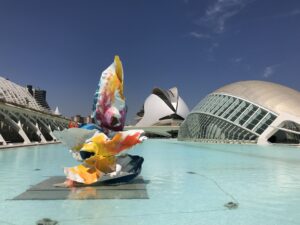
Even if you never step inside a single building, walking the complex is worth it. The grounds are open to the public, the paths run between the pools and under the concrete ribs, and the full walk from the Palau de les Arts down to the Oceanogràfic takes an hour with photo stops. You only pay at the individual attractions, and combined tickets usually work out cheaper than separate ones, so decide in advance which interiors you actually want.
2. L’Hemisfèric: the eye, the planetarium and the IMAX
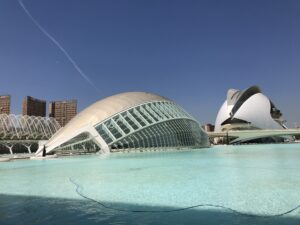
The most photographed part of the complex and also the oldest. The building is shaped like a giant eye that the water turns into a perfect ellipse, and inside there is a planetarium with a dome screen. Screenings are mostly in Spanish with headset translation, so check the programme in advance to make sure you get a show you can follow.
3. Museu de les Ciències Príncipe Felipe: three hours in the science museum
A long glass hall that looks like a whale skeleton from the outside and holds interactive exhibits you are allowed to touch on the inside. It is the one place in the complex where you can spend half a day in any weather, and with school age children it is a certainty. Without children, budget closer to two hours.
4. L’Oceanogràfic: the largest aquarium in Europe
The largest oceanographic complex in Europe, laid out by marine ecosystem from the Mediterranean through the tropics to the Arctic, with a tunnel under the shark tank and a dolphinarium. The main water lily shaped building is the work of Félix Candela, not Calatrava, to whom it is often wrongly credited. It is the most expensive ticket in the complex and the one with the longest queue, so buy online in advance and arrive as the doors open.
5. Palau de les Arts and L’Umbracle
Palau de les Arts Reina Sofía is the opera house that looks like a helmet set down on water, and even if you are not going in, walk right round it. L’Umbracle is the covered promenade of palms and climbing plants along the southern edge of the site, a place to get out of the sun and the best view down over the whole complex. Entry to the Umbracle is free.
6. Assut de l’Or bridge and the Àgora
The white cable stayed bridge with its single leaning pylon closes the complex on the eastern side and is one of the finest Calatrava pieces in the city. Next to it stands the Àgora, a blue covered arena used for concerts and exhibitions. The best shot of the bridge is from Turia Park below it, not from the bridge itself.
Valencia old town: what to see in the historic centre
The old town, Ciutat Vella in Valencian, is genuinely small and can be walked in a morning, although most people end up staying longer. The places below sit so close together that you can do them one after another on foot. The route step by step, where to start it and what to skip, is laid out in our separate article on Valencia landmarks.
7. Torres de Serranos: the gate you enter the old town through
Two heavy towers of Valencian Gothic, begun by Pere Balaguer in April 1392 and finished in March 1398. After the city prison burned down in 1586 they served for nearly three hundred years as a jail for the nobility, and during the Civil War they sheltered paintings evacuated from the Prado in Madrid. Today you can climb to the walkway on top, which gives you one of the best views over the roofs of the old town and the green Turia bed below.
8. Plaza de la Virgen: the square where the city started
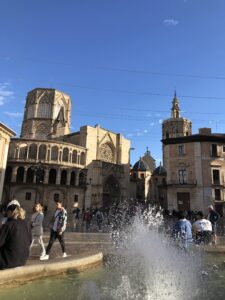
The Roman forum stood on this spot, and it is now the most agreeable square in the city. The Turia fountain splashes in the middle, people sit around it over coffee, the basilica of the Virgin of the Forsaken closes one side and the Gothic portal of the cathedral the other. Every Thursday the Tribunal de las Aguas meets here, the water court that settles disputes over irrigation in the fields around Valencia, and since 2009 it has been on the UNESCO intangible heritage list. The session lasts a few minutes, it is public and it is free. When a public holiday falls on the Thursday, the court sits on the Wednesday instead.
9. The cathedral, the Miguelete tower and the Holy Grail
Valencia Cathedral is several centuries stuck together, with Gothic, Renaissance and Baroque all visible at once, and it stands where a Visigothic cathedral was turned into a mosque under Moorish rule. The bishop had that building demolished in 1262 and started work on what you see today. Inside is a chapel holding the chalice venerated here as the Holy Grail, given to the cathedral by Alfonso V of Aragon in 1436. Beside it rises the octagonal Miguelete bell tower, with a spiral staircase up to a platform overlooking the whole old town. The stairs are narrow and used in both directions, so in high season expect a queue at the bottom and some backing up on the way to the top.
10. Lonja de la Seda: the silk exchange and the only UNESCO site in the centre
The most valuable building in the city and the only Valencian monument inscribed on the UNESCO list, which happened in 1996. The silk exchange was built between 1482 and 1533, the main trading hall was designed by Pere Compte and built between 1483 and 1498. The hall rests on eight spirally twisted columns that open into the vault like palm trees, and a gilded Latin inscription about honest trading runs round the walls. The visit takes half an hour and it is the best ratio of time to reward in the city.
11. Mercado Central: the market under the glass dome
An enormous market hall built between 1914 and 1928 in Valencian art nouveau, to a design by Alexandre Soler March and Francesc Guàrdia Vidal. It covers more than 8,000 square metres and ranks among the largest in Europe: coloured glass in the domes lets the light down onto stalls of ham, cheese, fruit, almonds and fish. People come here both to shop and to eat breakfast standing up. Mornings are much better, because around midday in high season you can barely get through the doors.
12. Torres de Quart: the second gate, with cannonball scars
The western counterpart to Serranos, a little more solid and without the decoration. It took a long time to build, from 1441 until 1493, and four master builders worked on it, Pere Compte among them. The facade is the interesting part: on 28 June 1808 French troops shelled it during the defence of the city, and the holes left by cannonballs and musket fire were deliberately left alone in every later restoration. More damage was added in 1873. You can climb it just as you can Serranos.
13. San Nicolás church: the Sistine Chapel of Valencia
An unremarkable church in a side lane from the outside, and one of the biggest rewards in the city on the inside. The 15th century Gothic building is covered from wall to wall in Baroque frescoes, painted by Dionís Vidal between 1697 and 1700 to designs by Antonio Palomino. After the 2016 restoration people started calling it the Sistine Chapel of Valencia. There is an entry fee, usually including an audio guide, and you would miss a great deal without it.
14. Plaza del Ayuntamiento and the city hall
The main city square, with flower stalls, a fountain and the facade of the city hall. For most of the year it is a transport hub and a reference point, but from 1 to 19 March crowds gather here every day at two in the afternoon for the mascletà, the daytime pyrotechnic show that you feel in your chest rather than hear with your ears. Anyone in Valencia in March should experience it at least once.
15. Plaza Redonda: the round square hidden between houses
A small circular square tucked inside a block, reached through four narrow passageways. Around the edge are stalls selling lace, embroidered fabrics and ceramics, and a fountain stands in the middle. It takes five minutes and it is one of those places you walk straight past if you do not know it is there.
16. Barrio del Carmen: the oldest and liveliest quarter
A maze of narrow lanes between the two gates, where crumbling facades alternate with murals, small bars and courtyards. By day it is a district for wandering and photographing, in the evening it is where people go for a drink. It is also where Valencia’s street art changes fastest, so the lane you walked in the morning can look different by nightfall.
17. Palacio del Marqués de Dos Aguas and the ceramics museum
A Rococo palace with a wildly carved alabaster portal that no camera walks past. Inside is the González Martí National Ceramics Museum, with a collection of Valencian ceramics, tiled walls and historic interiors. Even if ceramics leave you cold, the palace rooms themselves justify the ticket.
18. Estació del Nord: the station people visit without catching a train
The railway station just off the centre is one of the key buildings of Valencian art nouveau and has been a protected monument since 1987. The present building dates from 1917, although a station has stood on this spot since 1852. The concourse is decorated with mosaics and ceramic panels of orange trees and farm workers, and it takes five minutes to look round on your way out of the metro.
Museums, art and the stadium: things to do in Valencia when it rains
Valencia has more museums than three days can hold, so what follows is the shortlist worth changing your plans for. They come into their own on a rainy day or when the heat becomes unreasonable.
19. IVAM: the first modern art museum in Spain
The Institut Valencià d’Art Modern opened in February 1989 as the first centre for modern art in Spain. The collection is built around the work of the sculptor Julio González, who developed welded sculpture alongside Picasso, and today runs to roughly ten thousand objects. The building stands at the edge of Barrio del Carmen and a stretch of the medieval city wall is visible in the basement.
20. Museo de Bellas Artes: Velázquez, Goya and El Greco
The fine arts museum was founded in 1913 and holds around two thousand works, weighted towards the 14th to 17th centuries. On the walls are Velázquez’s self portrait, Goya’s The Swing and his portrait of Francisco Bayeu, El Greco’s Saint John the Baptist and paintings by Anthony van Dyck. It sits on the far bank of the former river next to the royal gardens, so the two combine into one walk.
21. Centro de Arte Hortensia Herrero: the newest gallery in town
A contemporary art gallery in the converted Valeriola palace at Calle del Mar 31. The building itself is the most interesting part: the renovation uncovered layers of the city beneath it, Roman, Visigothic, Islamic and Christian, and some of the finds are on show inside the exhibition. It closes earlier than the other museums, at three in the afternoon on Sundays.
22. Plaza de Toros and the bullfighting museum
The neoclassical arena next to Estació del Nord station was designed by Sebastián Monleón y Estellés and took a remarkably long time to build, from 1798 until 1859. It seats just under thirteen thousand people and takes its cue from Roman amphitheatres. Inside is the Museo Taurino, founded in 1929, with a collection of more than three thousand objects. You do not have to attend a bullfight; the tour of the arena and the museum is a separate thing.
23. Mestalla: the Valencia CF stadium
The home of Valencia CF stands inside the city, opened on 20 May 1923 and now holds 49,430 people, which makes it the largest stadium in the Valencian Community. If a match does not fit your dates, there is a tour taking in the dressing rooms and the players’ tunnel. Ticket prices for matches vary enormously with the opposition, so look early.
Parks, greenery and animals in Valencia
Want to slow down, spread out a picnic or look at something other than another monument? This is the part of the city for it.
24. Turia Park: the green channel that holds the city together
After the flood of 1957 the Turia river was diverted around the city, and the empty channel became a nine kilometre park that wraps around the old town and ends at the Ciudad de las Artes. It runs through lawns, pine groves, playgrounds, running loops and under old stone bridges that pass overhead. It is by far the pleasantest way to move around Valencia, and the place where you see how the city actually lives.
25. Parque Gulliver: the giant figure you climb on
In the southern stretch of Turia Park, between the Ángel Custodio and Reino de Valencia bridges, lies a roughly seventy metre long figure of Gulliver lying down, which children climb over and slide down. It opened in 1990 and entry is free. With kids it is the cheapest entertainment in the city, with the one catch that there is no shade over the middle of a summer day.
Valencia by bike is a different city
Valencia is as flat as a table and Turia Park works as a cycling spine with not a single junction on it. Hiring a bike here makes more sense than buying metro tickets, especially if you are staying near the centre. From the park you drop down to the Ciudad de las Artes, carry on to the port and arrive at the beach without ever sharing space with a car. The city has both a bike sharing scheme and ordinary rental shops, and you will find them along the main avenues.
- For children on bikes, count on a helmet. It is enforced.
- In July and August ride in the morning or after seven in the evening. In the middle of the day the channel is airless.
- At the southern end of the park is Gulliver, the giant reclining figure with slides built into it. Children last there longer than you expect.
26. Jardines del Real, known locally as Viveros
The largest city park, on the northern bank of the channel, on the site of a former royal residence. People come here for shade, and there are fountains, a rose garden, peacocks and open air concerts in summer. The Museo de Bellas Artes is right next door, so the two go together naturally.
27. Jardín de Monforte: the garden most people miss
A small neoclassical garden designed in 1859 by Sebastián Monleón y Estellés. In under twelve thousand square metres it packs in 33 marble sculptures on mythological themes, fountains and a pavilion, and since 1941 it has been protected as an artistic monument. It is the quietest corner near the centre and a favourite backdrop for wedding photographs.
28. Bioparc: the zoo where you cannot see the bars
At the western end of Turia Park lies the ten hectare Bioparc, which opened in 2008. It works on the zoo immersion principle: instead of fences, water channels, rocks and streams separate people from animals, so the enclosures read as a slice of Africa. Around four thousand animals of two hundred species live here, in savannah, equatorial forest, wetland and Madagascar zones. Together with the Oceanogràfic it is the surest bet in the city if you are travelling with children.
The sea, the beaches and the port in Valencia
Valencia is one of the few large European cities where you can stand in front of a Gothic exchange in the morning and lie on sand in the afternoon without leaving the city transport zone. Which stretch of sand to pick, where it is quieter and what to expect out of season is what our article on Valencia beaches is for.
29. Malvarrosa and Las Arenas: the city beaches you reach by tram
A wide band of sand with a long promenade, restaurants and sunbed hire, a few minutes from the centre by tram. In summer it is packed, out of season it makes a pleasant walk even without swimming. This is where you eat paella with a sea view, and equally where you are most likely to pay the tourist price for it.
30. Patacona: the quieter version next door
The same beach continuing northwards, with fewer people, newer places to eat and less of a crowd. When Malvarrosa fills up, walk fifteen minutes further along the promenade.
31. El Cabanyal: the fishermen’s quarter with tiled facades
The district between the centre and the sea, made up of low houses clad in coloured tiles. It was neglected for a long time and is now being restored and filling up with cafes and galleries without losing its character. It is the most photogenic walk in Valencia outside the old town, and it lies directly on the way to the beach.
32. Marina de Valencia: the port after the America’s Cup
The former racing harbour from the America’s Cup years has turned into a space of bars, events and water sports hire. A cycle path runs along it and you can see out over the docks and the sea. It works best in the late afternoon; in the middle of the day it is empty and hot.
Flavours, markets and neighbourhoods: what to eat in Valencia
33. Paella where they actually make it properly
Valencia is the birthplace of paella and locals are sensitive about it. Real paella valenciana is rice, beans and rabbit or chicken, with no seafood scattered on top for effect and absolutely no chorizo. It is a lunch dish, not a dinner. If you see a photograph of paella outside a restaurant on the main tourist street, walk one street further. The best of it is eaten in El Palmar by the Albufera, or in the places on Malvarrosa where Spaniards eat too.
34. Horchata with fartons
A cold drink made from tiger nut tubers, called chufa in Spanish, grown north of the city around Alboraya. It is served ice cold and you dip fartons into it, long sweet pastries. You drink it in a horchatería, either one of the historic ones in the centre or in Alboraya itself. It is the Valencian afternoon snack, and it costs a few euros, so roughly two to three pounds.
35. Mercado de Colón: the art nouveau market that is now a bistro
A market built between 1914 and 1916 to a design by Francisco Mora Berenguer in Valencian art nouveau, with a cast iron frame, coloured ceramics and brick ornament. Nobody buys vegetables in its 3,500 square metres any more: the building has been restored and now holds cafes, restaurants and a classic horchatería. An ideal mid morning coffee stop off the tourist route.
36. Ruzafa: the neighbourhood locals go to
South of the centre is a district with its own market, the best concentration of modern bistros and bars in the city and a nightlife that is not built on tourists. If you want to spend one evening somewhere with no queue for a photograph, come here.
37. Fallas: the biggest festival of the year
In March the city transforms. The main days run from 15 to 19 March, when giant figures of paper and wood stand in the streets, from 1 to 19 March the mascletà is fired every day at two in the afternoon, and on the night of 19 March every figure burns in the cremà. It is an enormous experience and simultaneously the busiest date in the calendar: book accommodation months ahead and expect noise until morning.
Day trips from Valencia: what to see nearby
38. Albufera and El Palmar: rice fields, boats and paella
The Albufera Natural Park lies about eleven kilometres south of Valencia and it is a completely different world from the city. The freshwater lagoon surrounded by rice fields covers more than 21,000 hectares, it has been a Ramsar wetland site since 1989, and rice has been grown here since the 18th century. The paddies also work as a filter that cleans the water coming out of the lagoon. The strongest thing you can do here is take a traditional boat out onto the water at sunset, when the surface changes colour and birds circle over the reeds.
The fishing village of El Palmar, whose fishermen’s guild set down its own rules as early as 1250, is where the restaurants cluster, and Spaniards drive out here for lunch because of them. One morning trip is enough, and you can do it by bus from Valencia or as an organised boat excursion.
39. Port Saplaya: coloured houses by the marina
North of the city, in the municipality of Alboraya, stands a cluster of brightly painted houses around canals and a yacht harbour, which locals call little Venice. It is small, an hour walks all of it, and you get there from the centre on public transport. Combine it with a horchatería in Alboraya, because the chufa is grown in the fields right around it.
40. Montanejos: a thermal spring in the mountains
A village 92 kilometres from Valencia, up in the interior mountains, visited for the Fuente de los Baños spring and for the turquoise pools in the river gorge. In summer it is busy and parking is a problem; out of season it makes a beautiful full day trip, but you need a car.
41. Alicante and Benidorm on the Costa Blanca
With more days in hand, the Costa Blanca opens up to the south. Alicante, with the Santa Bárbara fortress above the town, is an hour and a half by train and the easiest day trip without a car. Benidorm is the opposite of Valencia: high rises at the beach and holidaymaking on an industrial scale, but anyone who wants to see Spanish mass tourism with their own eyes has it close by.
How Valencia eats: lunch is around two, dinner after nine. Turn up at a restaurant at seven and you will have the room to yourself while the kitchen is still warming up.
Where to stay in Valencia
For a big city Valencia is pleasantly compact, so there is no truly bad choice. The difference is mostly in what you end up close to:
- Ciutat Vella (the old town): everything on foot, the most restaurants and bars, and also the noisiest and most expensive. The best choice for a short stay without a car.
- Ruzafa: ten minutes south of the centre, modern bistros, a local feel and more reasonable prices. The choice for a second visit.
- Around the Ciudad de las Artes: newer buildings, quiet, close to the complex and to Turia Park. Suits families and anyone who has arrived by car.
- By the beach (Cabanyal, Malvarrosa): the sea round the corner and a quarter of an hour into the centre by tram. Good in summer, dead out of season.
You can compare places to stay in Valencia on a single map through Stay22, which puts hotels and apartments from several booking sites side by side.
Where to eat in Valencia and what to try
Beyond paella and horchata, a few things here are worth ordering that you will not get elsewhere in Spain:
- Agua de Valencia: a cocktail of orange juice, sparkling wine, vodka and gin. It looks innocent. It is not.
- Arroz a banda and arroz negro: rice pans made with fish stock and with squid ink respectively, both lighter than paella.
- Esgarraet: a cold salad of roast pepper, salt cod and garlic, a classic tapa.
- All i pebre: eel in garlic and paprika, the speciality of the Albufera.
- Buñuelos de calabaza: pumpkin fritters, fried above all during Fallas.
The general rule: the further from the cathedral and the fewer photographs in the menu, the better. The markets, Ruzafa and the side streets of Barrio del Carmen are all safe ground.
Money, roughly: everything here is priced in euros, and 1 € is about £0.85, so a 20 € museum family ticket lands near £17 and a few euros for horchata and fartons is a couple of pounds. Card is accepted almost everywhere, though small bars and the market stalls still like cash.
Valencia with kids: how to build a day out of these places
Valencia is one of those cities where parents do not have to invent anything. The programme almost assembles itself and fits into three days without anybody complaining.
You reach Bioparc by metro to Nou d’Octubre, or simply along Turia Park if you are walking or cycling from the centre. Building a whole day from there is easy: Bioparc in the morning, shade in the park and a stop at Gulliver in the afternoon, a walk to the sea in the evening. On day two take the Oceanogràfic as soon as it opens and leave the afternoon for the science museum, where everything is meant to be touched.
Free things to do in Valencia
Valencia works on a minimal budget, because a large share of the places in this article cost nothing:
- The whole of Turia Park, including Parque Gulliver and the L’Umbracle promenade.
- Walking the Ciudad de las Artes from the outside, around the pools and over the Assut de l’Or bridge.
- Plaza de la Virgen, Plaza Redonda, Plaza del Ayuntamiento and getting lost in Barrio del Carmen.
- The water court session every Thursday by the cathedral.
- The city beaches Malvarrosa and Patacona, and the promenade in El Cabanyal.
- Mercado Central and Mercado de Colón, as long as you buy nothing.
- The mascletà on Plaza del Ayuntamiento through March.
Some museums also run one day a week or a late afternoon slot with reduced or free entry, but this changes, so check it on the museum’s own website.
What works best with children: the Oceanogràfic and its shark tunnel, the dome of L’Hemisfèric, the interactive floors of the science museum, Gulliver in Turia Park, Bioparc and the city beach a few minutes by tram from the centre. Six items, three days, done.
Getting around Valencia: airport to city centre, metro, tram and bike
This is the part people look up before they travel, and the answer to the most basic question is: yes, Valencia has a metro, and it is usable from the moment you land.
From Manises airport into the city centre
Valencia airport, officially Manises, lies eight kilometres west of the city. It is small and easy to read, and it is only a few minutes’ walk from arrivals to the metro entrance, so it spares you the trek you get at some other Spanish airports.
- The metro serves the airport on lines 3 and 5. Into the centre takes roughly 15 minutes, to the main station Estació del Nord about 20 minutes, and to the port around 30 minutes. For the vast majority of arrivals this is the simplest option.
- The bus is run by Fernanbus, the journey takes 30 to 35 minutes and the route calls at Mislata, Quart de Poblet and Manises.
- Taxis and apps earn their keep mainly on night arrivals or when you have suitcases and children with you. The rank is directly outside the terminal.
- Car hire desks are in the terminal. Inside the city, though, a car mostly slows you down. Parking in the centre is expensive and some streets are closed to traffic. Hire one for the day you head out of town.
Metro, tram and buses around the city
The Metrovalencia network mixes conventional underground lines with surface tram lines, which is why the map looks more complicated than the reality. Below ground the trunk lines cross the centre; above ground the trams take you to the sea and into the northern districts. On top of that there are the EMT city buses, which cover the places the rails do not reach, and they are most useful heading towards the Ciudad de las Artes.
Tickets come from machines in the stations and work on a zone system. If you expect more than two journeys a day, look in the machine for a multi journey or day option rather than single tickets. Actual fares change, so we are not going to guess at them; check them in the machine or in the operator’s app.
| Where | Best option | Note |
|---|---|---|
| Airport to centre | metro lines 3 and 5 | roughly 15 minutes |
| Centre to Ciudad de las Artes | bus, or bike through Turia Park | no direct metro |
| Centre to beach and port | tram | metro from the airport to the port is about 30 minutes |
| Centre to Bioparc | metro, Nou d’Octubre station | walkable through the park too |
| Across the whole city | bike | flat, and Turia Park has no junctions |
A practical note: the historic centre is walked on foot and there is no other way, because the lanes are narrow and crooked. You will use the metro mainly for the airport run, for Bioparc and for the sea. The rest you manage on your own two feet or on a bike.
How to get to Valencia
Direct flights to Valencia run from a number of UK and European airports, but routes and frequencies shift with the season, so compare your own dates rather than trusting a route that existed last summer. If nothing direct fits, flying into Barcelona or Alicante and continuing by train is a genuinely good plan B: the coastal railway works well and the run down from Barcelona is faster than most people expect. Estació del Nord, where those trains arrive, sits right beside the old town, so a rail arrival puts you straight into the middle of everything.
How many days to spend in Valencia
Short answer: three days. Three days gets you the Ciudad de las Artes without rushing, the historic centre on foot, time at the sea and an evening left over for eating. A fourth day is a bonus that almost always pays off, because it turns into a trip out of the city. Two days works as well, but something falls off the list, and a single day only makes sense as a stop on a longer run down the coast.
| Length of stay | What fits | Who it suits |
|---|---|---|
| 1 day | historic centre in the morning, Ciudad de las Artes in the afternoon and at dusk | a stop en route |
| 2 days (a weekend) | centre and the markets, Ciudad de las Artes, then either Oceanogràfic or the beach | a short break without children |
| 3 days | all of the above plus Turia Park by bike and an evening by the sea | the sweet spot for most people |
| 4 days | plus Bioparc or a trip to the Albufera | families with children |
One day itinerary
- Morning: the historic centre, the cathedral and the market, with coffee on one of the squares.
- Afternoon: move over to the Ciudad de las Artes, one building from the inside, the rest from the outside.
- Evening: the complex lit up, then dinner in the centre, remembering that people in Spain sit down to eat much later than you may be used to.
Two day itinerary
- Day 1: the centre, the market, lunch on the spot, then Turia Park heading south in the afternoon and the Ciudad de las Artes at dusk.
- Day 2: Oceanogràfic in the morning, the tram to the beach in the afternoon, dinner by the sea.
Three day itinerary
- Day 1: the historic centre on foot, the market, an evening walk around the squares.
- Day 2: the Ciudad de las Artes all day, Oceanogràfic first thing, the Hemisfèric or the science museum in the afternoon, photographs by the pools in the evening.
- Day 3: a bike through Turia Park all the way to the sea, the beach in the afternoon, a quiet dinner.
- Bonus day 4: Bioparc with children, or a trip to the Albufera Natural Park.
The best time to visit Valencia
Valencia works all year, but each season asks for a slightly different plan. In July and August it is hot and humid, the city only comes alive after dark and you spend the day in shade or in water. Spring and autumn are the most comfortable for sightseeing, because you can walk all day and the sea in autumn still holds the summer’s warmth. In winter Valencia is calm, cheaper and perfectly fine for walking; only the swimming drops out.
And then there is March, with the Fallas festival covered under number 37 above: the strongest single experience of the year and, at the same time, the week when the city is at its fullest.
Valencia, Málaga, Alicante or Barcelona?
Almost everybody weighs this up before booking, so here is the short comparison:
- Valencia or Barcelona: Barcelona has more famous buildings and more people in front of each one. Valencia is cheaper, calmer and everything in it is closer together. Barcelona for a first trip to Spain, Valencia for the second.
- Valencia or Málaga: Málaga is further south, warmer out of season and full of museums. Valencia wins on modern architecture and on travelling with children. Málaga for a winter break, Valencia for spring and autumn. If you are still torn, we have a full guide to what to see in Málaga.
- Valencia or Alicante: Alicante is smaller and simpler, and people go there mainly for the sea. Valencia offers far more to do away from the beach.
The October 2024 floods and what they mean for a visit
People ask about this, so we are not going to dodge it. On 29 October 2024 the region was hit by a DANA, an isolated upper level depression that brought extreme rainfall, and the flooding that followed cost roughly 238 lives. The worst affected places were the towns south and west of the city, above all Paiporta, Picanya, Torrent, Chiva and Utiel, and the Horta Sud area as a whole. The historic core of Valencia itself was largely spared, because the water was carried away by the diversion channel built after the 1957 flood, the same project that gave the city Turia Park. The city’s official tourism website currently lists no warnings and no closures, and Valencia is welcoming visitors as normal. We would still do one thing: check services in the Metrovalencia and Renfe apps before you travel, particularly if you plan to take trains out of the city. And if the idea of going to look at the damage crosses your mind, let it go. People live there.
Valencia FAQ
What to see in Valencia if you only have one day?The historic centre with the cathedral and the market in the morning, the Ciudad de las Artes y las Ciencias in the afternoon and evening. Go inside a maximum of one building and see the rest from the outside, because the complex looks best after dark.
How many days in Valencia is enough?Three days is ideal, four if you have children or want a trip out of the city. Two days covers the Ciudad de las Artes and the centre, but it leaves only a moment for the sea.
Does Valencia have a metro, and does it run from the airport?Yes. Manises airport lies eight kilometres west of the city and metro lines 3 and 5 serve it. The metro takes about 15 minutes into the centre, around 20 minutes to Estació del Nord station and roughly 30 minutes to the port.
How much are tickets for the Oceanogràfic and the City of Arts and Sciences?Prices depend on which buildings you combine and on the season, which is why we do not quote figures. The current price list and opening hours are on the official site, cac.es, where you can also buy online in advance. Everything is charged in euros, with 1 € working out at roughly £0.85.
Who designed the Oceanogràfic in Valencia?The water lily shaped building was designed by Félix Candela, not Santiago Calatrava, who is often credited with it. Calatrava is behind most of the other structures in the complex, including the Hemisfèric, the science museum and the opera house.
What is there to do in Valencia with kids?The safest combination is the Oceanogràfic, Bioparc and the Príncipe Felipe science museum, where everything is there to be touched. Add the giant Gulliver figure in Turia Park and an afternoon on the city beach.
Is Valencia worth visiting after the 2024 floods?The historic core of the city was largely spared and the official tourism website is currently reporting no closures or warnings. Even so, check current services in the Metrovalencia or Renfe app before you travel.
What can you see in Valencia for free?The whole of Turia Park including Parque Gulliver, the grounds of the Ciudad de las Artes from the outside, the old town squares, the city beaches and both market halls. The Thursday session of the water court by the cathedral is free too, as is the daily mascletà on Plaza del Ayuntamiento in March.
Potřebujete pomoct s cestováním?
-
Ubytování 🏨
Vyberte si to nejlepší ubytování, ať už jste kdekoliv, přes Booking.com. -
Půjčení auta 🚗
Auto si snadno najdete přes Booking.com, kde máte často slevu díky ubytování, nebo Rentalcars.com, kde porovnáte nabídky většiny půjčoven. -
Zážitky 🎟️
Přes GetYourGuide.com si vyberete z nejrůznějších výletů i zážitků po celém světě, navíc se zrušením zdarma do 24 h předem.